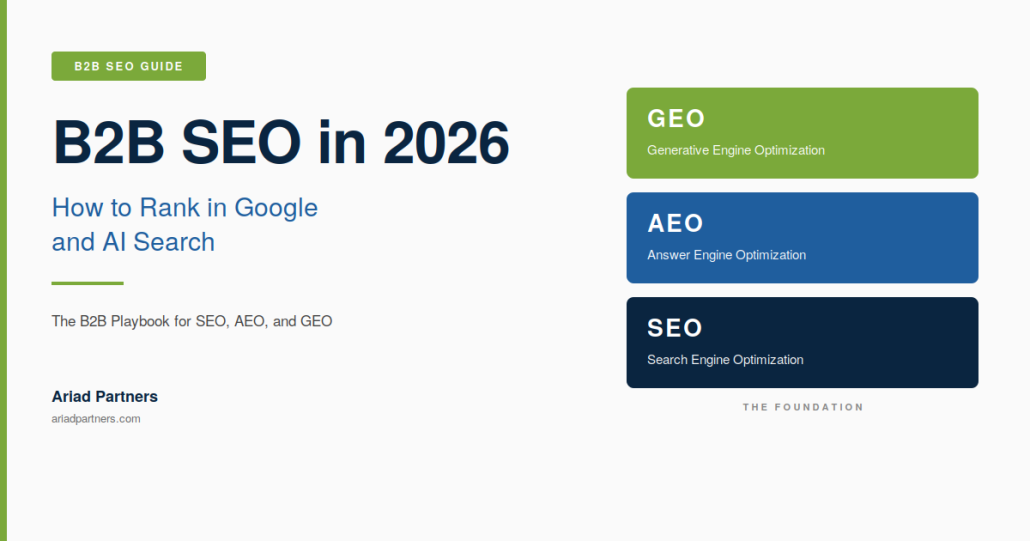
B2B SEO in 2026: How to Rank in Google and AI Search

Search isn’t one system anymore. When a buyer types a question into Google, two things now happen at once. The familiar list of blue links still loads, ranked the way SEO has always worked. Above it, an AI-generated answer pulls from a different set of sources, summarizes them, and often resolves the buyer’s question without a click.
That second layer is reshaping how B2B companies show up. Most of the SEO advice still circulating online treats search as it did in 2020. The teams getting cited in AI Overviews and ranking on page one of organic results are doing things differently.
This is the playbook we use with B2B clients and professional services firms at Ariad Partners to stay visible across both layers in 2026.
What Changed: From Search Engines to Answer Engines
A search engine indexes pages and serves links. An answer engine reads pages and generates responses. Google’s AI Overviews, Perplexity, ChatGPT Search, and Copilot all do the second thing. They’re trained or grounded in web content, then they synthesize answers from sources they decide to cite.
The shift has hit B2B technology buyers especially hard. According to BrightEdge data covering February 2025 through February 2026, the share of B2B tech queries that trigger an AI Overview grew from 36% to 82% in twelve months. For most B2B SaaS categories, AI summaries are now the default search experience, not the exception.
For B2B marketers, this changes three things at once:
- The funnel-top question that used to send a buyer to your blog now often gets answered in the AI summary instead.
- The companies cited in those summaries get attention from buyers who would otherwise have skipped the SERP entirely.
- Ranking number one on Google is no longer the ceiling of organic visibility. Being the source the AI quotes is.
This is why most agencies have begun discussing AEO (Answer Engine Optimization) and GEO (Generative Engine Optimization) as distinct disciplines. SEO is still the foundation. AEO and GEO are the two layers that determine whether AI search engines surface and credit you.
The SEO Foundation That Still Drives Results
Old-school SEO didn’t go away. It became table stakes. AI search engines pull from indexed content, which means everything Google needs to crawl and rank you well, AI engines need too.
Technical Health
Site speed, mobile responsiveness, secure HTTPS, clean redirect logic, and crawlable URLs are the floor. Google Search Console, Lighthouse, and your hosting provider’s diagnostics will surface most issues. For B2B sites with marketing automation tools layered in (HubSpot, Marketo, Pardot), watch for tracking scripts and chatbots that slow first contentful paint to the point of hurting both rankings and conversion.
Information Architecture and Internal Linking
A well-structured site tells search engines (and AI engines) which pages are most important. Pillar pages link to topic clusters, topic clusters link back, and the strongest commercial pages get the most internal links. This is the same logic behind effective inbound marketing site architecture: make it easy for both visitors and crawlers to find what matters. If you’re a B2B SaaS company, your /pricing/, /platform/, and /integrations/ pages should be one or two clicks from the homepage with multiple internal links pointing to them.
Authority Signals
Backlinks from credible domains still matter. So does brand search volume, third-party reviews on G2 and Capterra, and consistent NAP data for any office locations. AI engines weigh third-party validation heavily because they need signals beyond what’s on your own site.
Keyword Research for Pipeline, Not Just Traffic
This is where most B2B SEO programs go wrong. They optimize for traffic volume, then wonder why the pipeline doesn’t move. SaaS companies in particular need keyword strategies that map to revenue, not impressions.
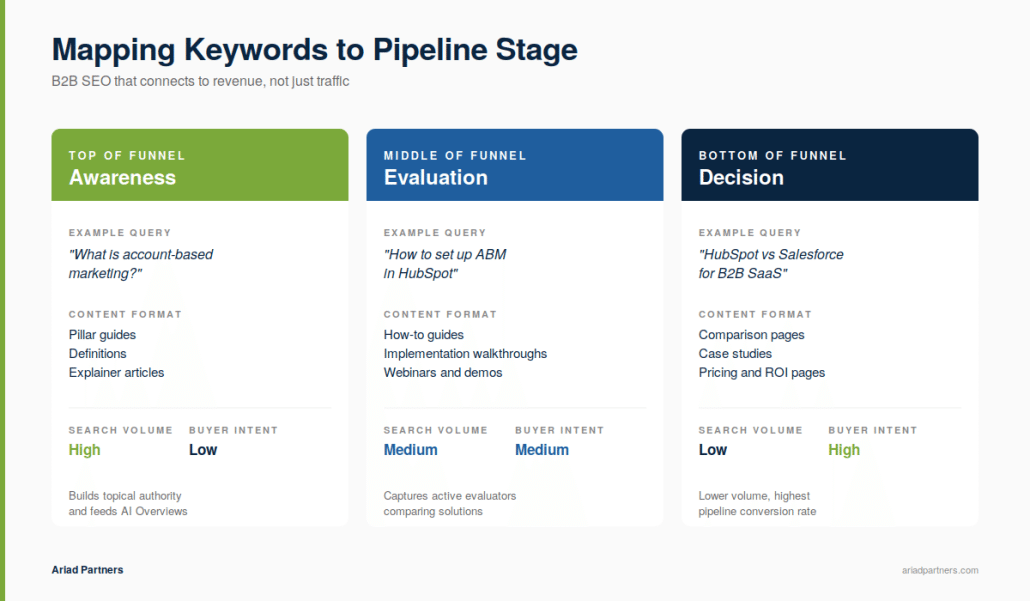
Map Keywords to Pipeline Stage
Top-of-funnel keywords (“what is account-based marketing”) drive awareness traffic. Middle-of-funnel keywords (“how to set up account-based marketing in HubSpot”) attract evaluators. Bottom-of-funnel keywords (“HubSpot vs Salesforce for B2B SaaS”) attract buyers comparing solutions. Each stage needs different content formats: explainers, how-to guides, comparison pages, and case studies. The mapping should reflect where buyers actually sit in their journey, not where you wish they were.
A common mistake: producing 50 top-of-funnel articles and zero comparison pages. The pipeline-influencing pages are usually the ones with lower search volume and higher conversion intent.
Question-Based Research for AEO
AI search engines favor questions because they mirror how users phrase prompts. AlsoAsked, AnswerThePublic, and the People Also Ask data in Google itself will show you the actual questions buyers are typing. Build content blocks that answer those questions directly, in 40 to 80 words, and you’re more likely to be the source AI cites.
Long-Tail and Conversational Queries
Voice search and AI prompts are conversational. “B2B SEO agency for SaaS companies in Pennsylvania” is the kind of phrase almost no one types into classic Google but is exactly how someone might prompt an AI assistant. Long-tail phrases with clear intent are now valuable in their own right.
On-Page Optimization for Humans and AI Parsers
Every page should be readable by two audiences: a human scanning for value and a large language model parsing for facts. Both want clear structure, accurate claims, and direct answers.
Title Tags, Meta Descriptions, and Headers
Title tags still drive click-through rate in classic SERPs. Headers (H1, H2, H3) tell both Google and AI parsers how the page is structured. Use Title Case, include the primary keyword in the H1 and at least one H2, and keep title tags under 60 characters.
Schema Markup That Matters in 2026
Structured data is the most underused tool in B2B SEO. Schema markup tells search engines exactly what a page contains: an article, a product, an FAQ, a how-to. The schemas that consistently pay off:
- Article schema for blog content
- FAQPage schema for any Q&A section
- Organization schema for the company itself
- Product schema for SaaS platforms
- BreadcrumbList for navigation
- HowTo schema for instructional content
Implement these via JSON-LD in the page head. WordPress sites can use plugins like RankMath or Yoast for the basics, but custom schema for SaaS-specific use cases often needs to be hand-coded.
Citation-Friendly Content Patterns
Write paragraphs that stand alone. AI engines lift content in chunks, so a self-contained paragraph that answers a question completely is more likely to be quoted than one that depends on the surrounding flow. Use clear topic sentences. Lead with the answer, then explain.
Off-Page Authority in the AI Search Era
Off-page used to mean backlinks. Now it means everywhere your brand shows up online, because AI engines crawl far more sources than Google’s classic algorithm rewards.
Backlinks Still Matter (and Quality Matters More)
A handful of links from authoritative industry publications outperforms dozens of links from low-quality blog networks. Earn them through guest contributions, original research, expert quotes in journalism, and being the source other people want to cite.
Brand Mentions and Unlinked Citations
AI engines weigh unlinked brand mentions almost the same as backlinks. Press coverage, podcast appearances, conference talks, and Reddit discussions where your brand gets named all contribute to the entity recognition that AI search engines use to decide who’s a credible source.
Where AI Engines Actually Look
Reddit, G2, Capterra, industry Slack communities indexed by Google, YouTube transcripts, and major industry publications are heavily represented in the training and grounding data for most LLMs. A strong G2 profile, an active and helpful Reddit presence, and a YouTube channel can have an outsized impact on whether your brand surfaces in AI answers.
AEO and GEO: The Layers Most B2B Sites Are Missing
Answer Engine Optimization (AEO)
AEO is the practice of structuring content to be the source AI engines cite when answering user questions. Done well, it shows up in Google’s AI Overviews, Perplexity citations, and similar formats.
The basics:
- Identify the questions your buyers actually ask
- Write direct, citation-length answers (40 to 80 words) at the top of relevant sections
- Use FAQPage schema markup
- Maintain factual accuracy and link to original sources for any data points
Generative Engine Optimization (GEO)
GEO is the broader practice of influencing how generative AI systems represent your brand, including in models that don’t search the live web. This involves both AEO tactics and longer-term work: getting your brand into industry datasets, third-party reviews, and the kinds of authoritative sources that show up in model training data.
GEO is harder to measure directly because there’s no equivalent of Google Search Console for AI assistants. The inputs (citations, brand mentions, third-party validation) are trackable, and the output (whether your brand surfaces in AI conversations) can be tested by prompting AI systems with relevant queries.
How to Track AI Search Visibility
Manual prompt testing across major AI engines is the most reliable starting point. Pick 20 to 50 prompts your buyers might use, run them through ChatGPT, Perplexity, and Gemini monthly, and track whether your brand surfaces. Tools that monitor AI mentions are emerging quickly. Semrush, Ahrefs, and others now have AI visibility features. None is perfect yet, but the category is maturing fast.
Measuring What Matters
Traditional SEO metrics still apply. They’re just no longer the whole story.
Traditional SEO Metrics
Organic traffic, keyword rankings, click-through rate, indexed pages, and Core Web Vitals tell you how the SEO foundation is performing. Watch the click-through rate carefully: Seer Interactive’s September 2025 research found organic CTR drops by 61% for queries where an AI Overview appears. A position-one ranking in 2026 isn’t worth what a position-one ranking in 2022 was, and your reporting needs to reflect that.
AI Search Metrics
Brand mentions across AI engines, citation share for target queries, AI Overview presence, and impression data from Google Search Console (which now includes some AI Overview impressions) tell you how AI search is performing.
Pipeline Metrics
For B2B, this is the layer that matters most. Marketing-qualified opportunities sourced from organic, pipeline influenced by content, deal velocity for organic-sourced opportunities, and revenue tied to organic touches across the journey. HubSpot, Salesforce, and dedicated attribution tools can connect SEO performance to actual revenue, but only if your sales and marketing teams are aligned on definitions and handoffs.
There’s a counterintuitive finding worth flagging: AI search traffic is small in volume but disproportionately high in quality. Ahrefs research found AI search visitors generated 12.1% of signups despite accounting for only 0.5% of total traffic, converting roughly 23 times better than traditional organic visitors. Buyers arriving from AI search engines have already done their research and narrowed their options. They’re at the bottom of the funnel before they ever land on your site.
If your team is still reporting SEO success in traffic numbers alone, you’re optimizing for the wrong scoreboard.
A 90-Day Plan to Get Started
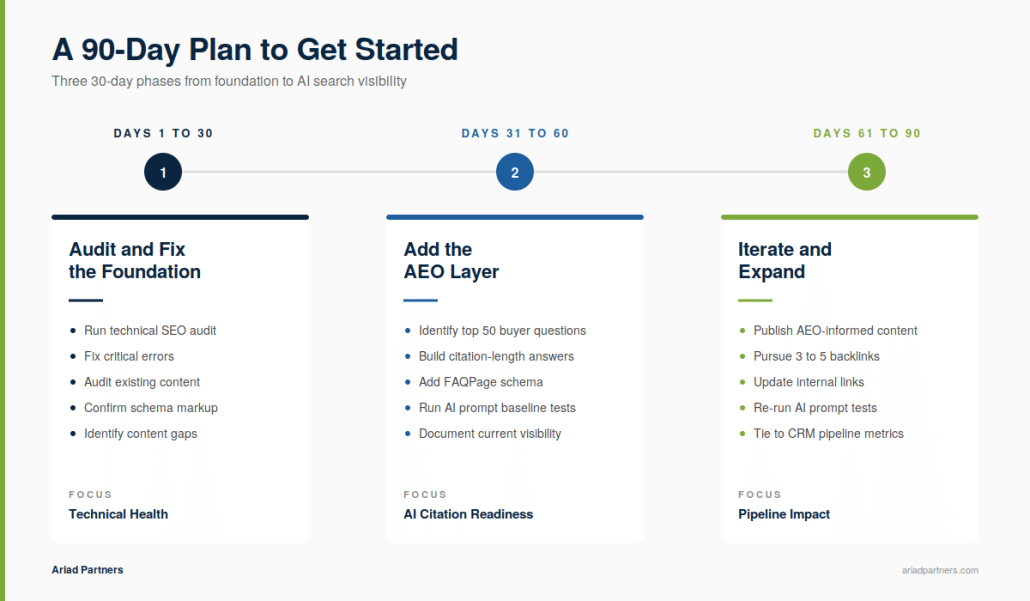
Days 1 to 30: Audit and Fix Foundation
Run a full technical audit (Screaming Frog, Sitebulb, or Semrush Site Audit). Fix critical errors. Audit current content against the keyword-to-pipeline-stage map and identify gaps. Confirm schema markup is in place on the highest-value pages.
Days 31 to 60: Add the AEO Layer
Identify the top 50 questions your buyers ask. Build or update content blocks with direct, citation-length answers. Add FAQPage schema to relevant pages. Run baseline AI prompt testing across major engines and document where you currently surface.
Days 61 to 90: Iterate and Expand
Publish new content informed by the AEO research. Pursue 3 to 5 high-value backlinks. Update existing high-traffic pages with stronger internal links to commercial pages. Re-run AI prompt tests and compare to baseline. Begin tying SEO and AEO performance to pipeline metrics in your CRM. If you want a structured framework to start auditing your SEO data to begin your inbound journey, download our free SEO Report Template.
Free SEO Report Template
Download our free SEO report template to get started. It includes all the sections above, pre-built formulas, and guidance on what to include in each section.
Download the Free SEO Report Template
The template works in Google Sheets or Excel and can be customized for your specific needs and branding.
Free SEO report template
Stop building SEO reports from scratch
Get 8 pre-built sheets covering traffic, rankings, technical health, backlinks, and AI search visibility, plus a one-page metrics reference card. Works in Excel or Google Sheets.
Common Questions


Leave a Reply
Want to join the discussion?Feel free to contribute!