
Inbound vs. Outbound Marketing: Differences, Examples, and Where to Spend

Inbound. Outbound. And everything in between.
If you run a business, you have probably heard these terms a hundred times and still wonder what they actually mean in practice.
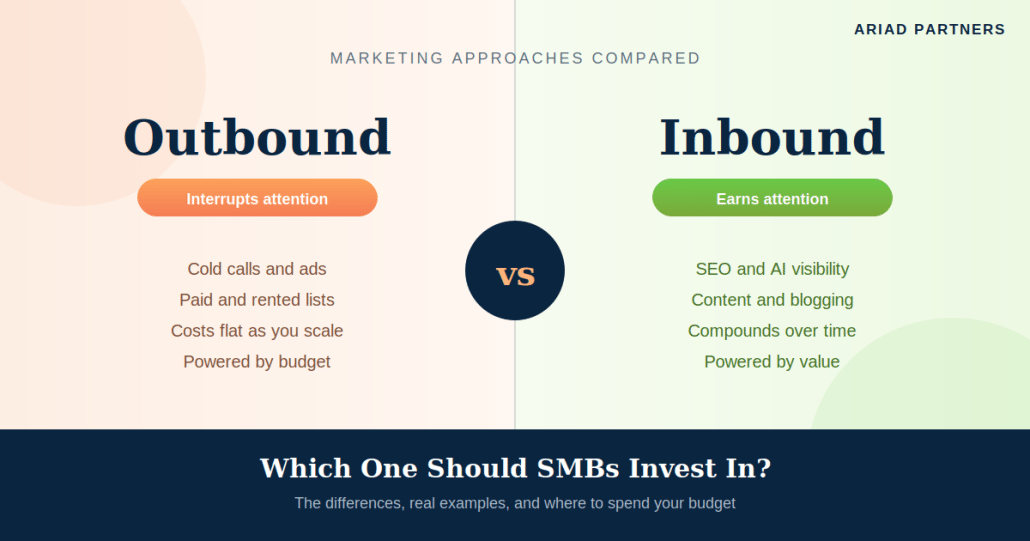
Here is the simplest way to think about it. Inbound marketing earns attention by helping people find you when they are actively researching. Outbound marketing pushes messages out to people whether they asked for them or not.
This page breaks down the difference between inbound and outbound marketing, includes real-world examples of each, and explains how to decide where your inbound marketing dollars should go for the best return.
The Difference Between Inbound and Outbound Marketing
What is inbound marketing?
Inbound marketing attracts customers by publishing content and building visibility where buyers research, including Google, AI search tools, social platforms, email, and industry resources. The goal is to provide helpful answers before a buyer is ready to talk to sales.
Common inbound tactics include:
- SEO content and blog articles
- Downloadable guides and templates
- Email nurturing sequences
- Webinars and videos
- Organic social distribution
- Lead capture and automation workflows
- AI search optimization
What is outbound marketing?
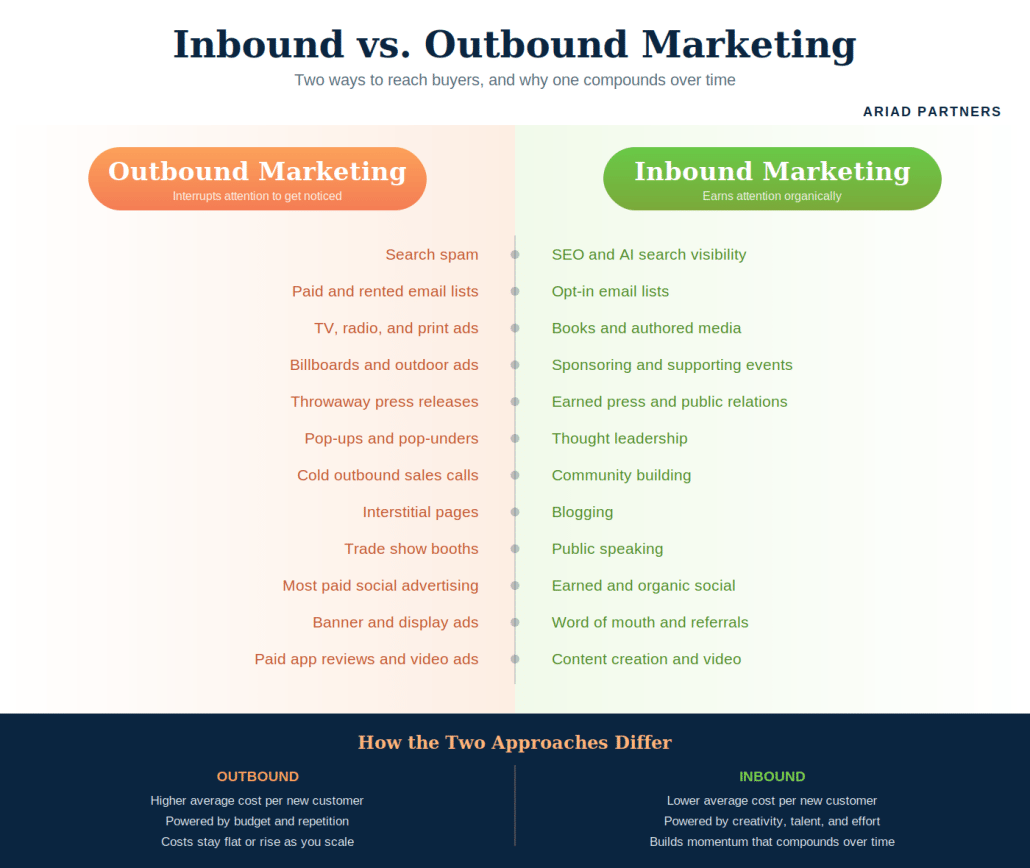
Outbound marketing, sometimes called marketing outbound, is when you reach out first to grab attention, often broadly. It can work, but it is typically more expensive per lead and less targeted unless you have strong segmentation and strong offers.
Common outbound tactics include:
- Cold email and cold calling
- Trade shows and sponsorships
- TV, radio, and direct mail
- Paid ads with interruptive targeting
- Purchased lists, which carry high risk and low trust
Inbound Marketing vs. Outbound Marketing: The Core Difference
If you remember one thing, let it be this:
- Inbound marketing: people are already searching, and you show up with value
- Outbound marketing: you interrupt attention and hope it lands
That is why inbound tends to generate higher-intent leads over time. The buyer is already in problem-solving mode when they find you.
Inbound Marketing vs. Outbound Marketing Examples
Here are clear inbound marketing vs outbound marketing examples you can picture immediately.
HVAC Contractor
Inbound: a “furnace not heating” blog post ranks on Google, and the reader books an appointment. Outbound: postcard mailers sent to 10,000 homes advertising a seasonal discount.
B2B Software Company
Inbound: an SEO page answers “best CRM for contractors,” and the visitor downloads a comparison checklist. Outbound: paid ads pushing “book a demo” to a broad job-title audience.
Professional Services
Inbound: a webinar and nurture emails educate prospects until they are ready to engage. Outbound: a cold outreach sequence asking for a meeting before trust exists.
These practical inbound and outbound marketing examples show why inbound often feels slower at first, yet stronger and more consistent once it compounds.
Inbound and Outbound in Digital Marketing: What Changed?
Today, buyers do not just Google it. They ask AI tools, silently compare vendors, read reviews and case studies, and only then talk to sales.
This shift makes inbound and outbound in digital marketing look different than it did even a few years ago. Inbound now includes SEO plus AI visibility, which means showing up in AI answers and summaries. Outbound now relies heavily on segmentation, personalization, and retargeting to stay efficient.
The change is measurable. Semrush’s study of more than 10 million keywords found that Google’s AI Overviews appear most often on informational queries, the exact content type that once drove top-of-funnel discovery for B2B sites. For SMBs, that makes AI search visibility a core part of inbound rather than an optional extra.
SEO: Inbound or Outbound?
A common question we hear is whether SEO is inbound or outbound. SEO is an inbound channel. It helps you earn traffic when someone is actively searching, researching, or comparing solutions. The long-term win is that SEO builds a compounding asset, visibility that does not disappear the moment you stop spending.
Why Use Inbound Marketing?
Inbound marketing works because it aligns with how people actually buy.
It is harder to ignore
Helpful content does not get skipped the way ads do. When someone is searching, they want information.
Your inbound marketing dollars compound
Outbound often resets each month with new spend and new results. Inbound builds assets that keep working: SEO pages that continue to rank, email sequences that continue to nurture, and content that gets reused and repurposed.
It generates higher-quality leads
Inbound leads frequently convert better because they have already self-qualified through research. This effect is showing up clearly in AI-driven discovery. In a June 2025 study of over 500 B2B and marketing topics, Semrush found that AI-referred visitors were about 4.4 times as valuable as traditional organic visitors, measured by conversion rate. In Ahrefs’ own published data, AI search made up just 0.5% of site traffic but drove 12.1% of signups, which the company described as a 23x conversion edge for its single-site results. The takeaway for SMBs is consistent: visitors who arrive already informed are closer to buying. The advantage is strongest for considered B2B purchases and weaker for impulse e-commerce.
Inbound Marketing Dollars: Where Should You Spend?
If you are deciding how to allocate inbound marketing dollars, a strong baseline is:
- SEO and content development, your compounding traffic engine
- Conversion assets such as lead magnets, landing pages, and offers
- Email nurturing and automation to turn interest into pipeline
- Measurement, so you know what is working and why
Outbound can still play a role, but the most sustainable strategy is usually inbound as the foundation and outbound as a targeted amplifier rather than a spam cannon.
Channels of Inbound Marketing
There is no single way to build an inbound marketing plan that works for your business. The best approach is to try a combination of channels, collect data, and adjust your strategy accordingly. That said, the data consistently points to search as the anchor. Organic search remains one of the largest sources of website traffic for most businesses, and for B2B and professional services it is often the single largest channel. The picture is shifting, though. Semrush’s 2026 traffic channel study found organic search growing only modestly while AI-driven traffic, though still small, grew faster than any other channel. The practical reading for SMBs: search is still the foundation, with AI visibility as the fast-growing layer on top.
Here is more on the cornerstone channels that make inbound marketing work.
1. SEO
Optimizing your website to rank higher in search results boosts your visibility when buyers are looking. When people need to find something, a search engine is usually their first stop. Potential clients search terms like “roofing contractor New York” or “online CRM software” every day, and most find what they need on the first page. If your business is on that page, you have just made their short list of vendors to consider.
2. Content Marketing
Once visitors reach your site, you want to offer educational, top-of-funnel content that helps them through the buying process. In exchange for that content, you earn a prospect’s email address, which you can use to nurture the lead and build trust over time.
3. Email
Once you have been found and captured a lead’s email, you nurture that relationship with targeted, useful campaigns. By tracking what interests your prospects, you can see what is working and refine your email strategy for better results.
4. Social Media
Social media helps you increase your reach, the number of people who see your brand and content. Build profiles on the platforms your audience actually uses, and focus on delivering interesting content and real value rather than constant self-promotion. Paid options on these platforms let you put a defined budget behind your best posts to reach more of your target audience.
5. Blogs
Your blog is the ticket to building trust with potential customers. When people search for solutions to their problems, you want your posts to appear in the results. Once they have clicked and read your content, they are far more likely to explore what else you offer and become customers.
6. Infrastructure
An important part of any inbound program is the technology that automates the work and provides the analytics you need to keep improving. Whether you use a platform like HubSpot or assemble tools such as Gravity Forms, WordPress, and Google Analytics, you need the right infrastructure in place to execute the strategy.
The Bottom Line: Inbound vs. Outbound
If you are growing a business and want predictable revenue, inbound becomes your long-term engine, especially when your budget is limited and efficiency matters.
Outbound can still be useful in specific situations such as events, product launches, or targeted account-based marketing. Many businesses, though, lean too heavily on outbound and underinvest in the inbound assets that steadily lower cost per lead over time.
If you want marketing that keeps working even when you are not actively spending, inbound is the answer. See how our inbound marketing services turn that approach into a connected system for your business.
Frequently asked questions
What is the difference between inbound and outbound marketing?
Is SEO inbound or outbound marketing?
What are examples of inbound and outbound marketing?
Which is better for a small business, inbound or outbound marketing?
Is inbound marketing cheaper than outbound marketing?
Does inbound marketing include AI search visibility?
Free AI visibility audit
Is your business showing up when buyers ask AI?
See how ChatGPT, Perplexity, and Google AI Overviews describe your business compared to competitors, with a prioritized fix list. Free for B2B SMBs, delivered in 5 business days.




Leave a Reply
Want to join the discussion?Feel free to contribute!