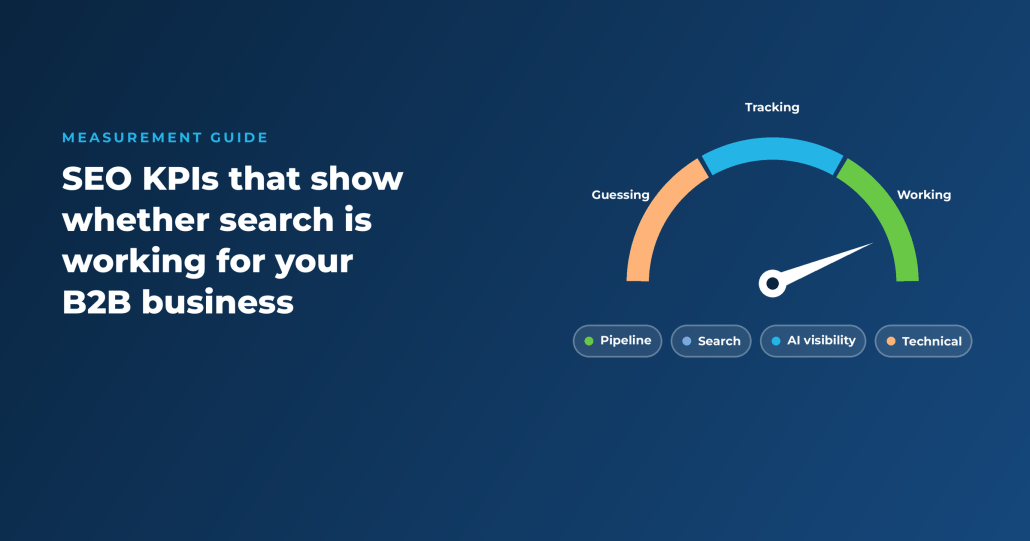
SEO KPIs that show whether search is working for your B2B business

What are SEO KPIs?
SEO KPIs (key performance indicators) are measurable signals that tell you whether search is actually doing its job for your business: how often buyers find you, whether they take action once they land, and whether those actions ever turn into pipeline. They’re a subset of search engine optimization metrics; every KPI is a metric, but only the metrics tied to a real business outcome get to wear the KPI label.
Here’s the thing, though: most of the SEO KPI lists out there were written for in-house SEO teams with a dedicated analyst and the budget to match, and if you’re running a 10 to 50-person B2B company, a dashboard with forty numbers on it is more likely to bury you than help you. What you’re really after is the short list that tells you whether to keep investing, change course, or pull the plug. And that short list has shifted over the past couple of years, as Google AI Overviews, ChatGPT, and Gemini now answer many questions before anyone clicks a link.
Four types of SEO KPIs to track
1. Pipeline KPIs
If you only track a few SEO KPIs, make them the ones that connect search to pipeline; they’re the numbers that hold up when your CEO (or your accountant) asks what all this SEO work is actually getting you.
| KPI | What it tells you | Where to find it |
|---|---|---|
| Organic-sourced conversions | Whether search visitors take action (form fills, consultation requests, calls) | GA4 key events filtered to organic search |
| Organic-sourced pipeline | The value of opportunities that started with a search | Your CRM’s original source field (in HubSpot, Original Source = Organic Search) |
| Conversion rate by page type | Which pages earn leads and which only earn visits | GA4 landing page report, grouped by service pages, blog posts, and resource pages |
| Branded search volume | Whether more people are looking you up by name | Google Search Console queries containing your company name |
Branded search is the one I’d ask you not to skip, because it rarely gets the attention it deserves. When an AI answer mentions your company, some people reading it will hop over to Google and type in your name, so a bump in branded searches can be one of the first places where AI visibility shows up in the data you already own.
One more thing worth saying out loud: B2B buying cycles are long, and inbound is a marathon, not a sprint. Review your pipeline KPIs quarterly and try not to judge them week to week; a single month of organic conversions is too small a sample to mean much, whereas three quarters of data gives you a real read on whether search is pulling its weight.
2. Search performance KPIs
Search performance KPIs answer two questions: can the right buyers find you in Google, and are the visits you’re earning worth having?
| KPI | What it tells you | Where to find it |
|---|---|---|
| Organic clicks | How many visits search actually sends you | Google Search Console Performance report |
| Non-branded organic clicks | Whether you’re reaching buyers who don’t know your name yet | Search Console, with a query filter excluding your brand |
| Rankings for a defined keyword set | Where you stand on the searches tied to your services | A rank tracker (Semrush Position Tracking, for example) |
| Organic engagement rate | Whether visitors stick around or bounce straight back to Google | GA4 engagement rate, organic search segment |
| Pages earning clicks | How much of your site is pulling its weight in search | Search Console, count of pages with at least one click |
When it comes to rankings, track a defined list of keywords tied to what you actually sell. The sitewide average position blends in hundreds of queries that have nothing to do with your business, so it can happily climb while the rankings you care about slip (or drop even as they’re improving, which is just as confusing).
And when you’re trying to figure out whether something worked, lean on clicks before impressions or CTR; clicks are the most dependable number in Search Console right now, and I’ll explain why in the metric traps section below. If you’d rather have someone own this whole set of numbers for you, check out our organic SEO services.
3. AI visibility KPIs
AI visibility KPIs measure whether AI-generated answers from Google AI Overviews, ChatGPT, Gemini, and Perplexity mention or cite your company when buyers ask questions in your category. They’re the new kid on the block as far as SEO KPIs go, and for a lot of B2B small businesses they’re the ones nobody’s tracking yet.
| KPI | What it tells you | Where to find it |
|---|---|---|
| AI Overview citations | How often Google’s AI answers link to your pages | Semrush AI Visibility or a similar AI tracking tool; Search Console’s Generative AI report (impressions only) |
| Brand mentions in AI answers | Whether AI tools name your company, linked or not | AI visibility tools with tracked prompts |
| Platform coverage | Whether you show up across ChatGPT, Gemini, and Perplexity, or only in Google | The same tools, broken out by platform |
| AI referral traffic | Visits arriving from AI assistants | GA4 referrals from chatgpt.com, perplexity.ai, and gemini.google.com |
Pay as much attention to platform coverage as you do to the totals. If nearly all of your AI visibility comes from AI Overviews and you barely register in ChatGPT or Gemini, you’re carrying real concentration risk; one change to how Google builds its overviews could take most of that visibility with it.
It also helps to know that composite AI visibility scores bounce around from week to week. So if mentions, citations, and audience all went up over the period, and the headline score dipped anyway, that dip is noise, and you can safely leave it alone.
One more wrinkle worth knowing: clicks from Google’s AI Overviews and AI Mode land in GA4 as regular organic search, so your AI referral numbers only capture tools like ChatGPT, Perplexity, and Gemini. If AI referral traffic looks small, that’s part of the reason.
Not sure where you stand today? An AI visibility audit maps where AI tools mention you, where they’re mentioning your competitors instead, and which gaps are worth closing first.
4. Technical SEO KPIs
Think of technical SEO KPIs as guardrails; you check them once a month and step in when one moves, because a site with technical problems quietly drags down every other number on this page.
| KPI | What it tells you | Where to find it |
|---|---|---|
| Indexed pages vs. pages you want indexed | Whether Google can see the pages that matter | Search Console Page indexing report |
| Core Web Vitals status | Whether pages load and respond fast enough for real visitors | Search Console Core Web Vitals report |
| Crawl errors and broken links | Whether visitors and crawlers hit dead ends | Search Console, plus a site audit tool |
| Priority pages never crawled | Whether important pages are invisible to Google | Search Console URL Inspection |
That last one catches more small business sites than you’d expect. A service page with no internal links pointing to it can sit uncrawled for months, and a page Google has never crawled can’t rank in search results or get cited in an AI answer.
SEO metrics you should be measuring… cautiously
Some of the SEO metrics you should be measuring can also lead you astray, and a few of the worst offenders come straight from Google.
- Impression inflation from AI Overviews. When a link to your page shows up in an AI Overview or AI Mode, Search Console counts an impression in your regular Performance totals, even if the searcher reads the answer and never clicks through. So if you’re staring at high impressions and a CTR close to zero, AI Overview exposure is the likely culprit, and it’s a mistake to read that as a ranking gain.
- The Search Console impressions logging error. Google confirmed that a logging error kept Search Console from accurately reporting impressions from May 13, 2025 until April 27, 2026, and that the fix brought reported impressions back down (Google, Data anomalies in Search Console). Clicks weren’t affected, so for any report that covers that window, lean on clicks and set impression-based metrics (CTR included) aside.
- New AI reports, new anomalies. Search Console’s Generative AI report only launched in June 2026, it shows impressions with no click data, and it’s a filtered slice of the impressions already in your Web search totals (so don’t add the two together). Google has also already logged a reporting error against it, starting August 13, 2026, that understated AI and Discover data (Relevant Audience). Before you react to a sudden swing, check Google’s data anomalies page; it’ll save you a lot of unnecessary worry.
- Sitewide average position. It averages every query you appear for, relevant or not, which means it tells you very little about the searches your buyers are actually running.
- Total keywords ranked. Your site can rank for thousands of terms that will never send you a buyer, so count the keywords tied to your services and let the rest go.
- Traffic without conversions. A blog post that pulls big numbers and zero leads can still earn its keep for brand awareness, but it’s hard to call it proof that SEO is working for the business.
So whenever a number moves, ask yourself one question before you do anything else: did buyers actually behave differently, or did the way Google counts them change?
What to include in an SEO KPI report
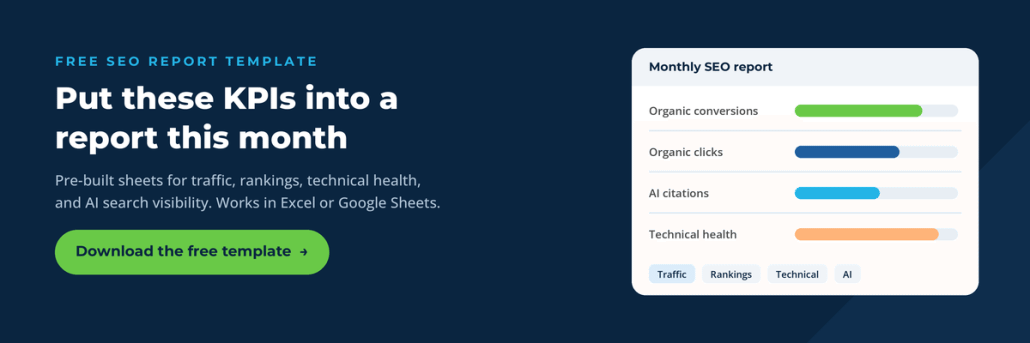
A useful SEO report fits on one page, opens with pipeline, and wraps up with what’s coming next. Here’s the order I’d use for a monthly report to a small business leadership team:
- Pipeline summary. Organic-sourced conversions and pipeline for the month, compared with the same month last year.
- Search performance. Organic clicks, non-branded clicks, and any movement on your defined keyword set.
- AI visibility. Citations and mentions by platform, with a quick note on anything that shifted.
- Technical health. Only the flags that need action; if nothing moved, a single line saying so is plenty.
- What we did. The work completed this month, tied to the KPI it’s meant to move.
- What’s next. Next month’s priorities and the number each one should change.
Whenever you can, compare against the same month last year (marketing 101, but it’s easy to forget); B2B search has seasonal swings around holiday weeks and fiscal year-ends that make month-over-month comparisons awfully noisy.
Does anyone on your team actually own this report? If it’s nobody’s job, or it gets built every month and never discussed, that’s usually a sign the strategy doesn’t have an owner either. A fractional CMO who owns both strategy and execution can close that gap without bringing in a second vendor.
Frequently asked questions
What are the most important SEO KPIs?
What is the difference between SEO metrics and SEO KPIs?
How do you measure SEO performance for a small business?
How do you measure visibility in AI search?
What should an SEO KPI report include?
How often should you report on SEO KPIs?
Want SEO KPIs your leadership team will actually read?
As a B2B inbound marketing agency, Ariad Partners has been helping SMBs grow through SEO, content marketing, and AI search visibility since 2011. I’ll help you narrow down the SEO KPIs that matter for your business, set up tracking you can trust, and then roll up my sleeves and do the work that moves them (strategy and execution, all in one engagement). Let’s talk about your SEO KPIs.

Leave a Reply
Want to join the discussion?Feel free to contribute!