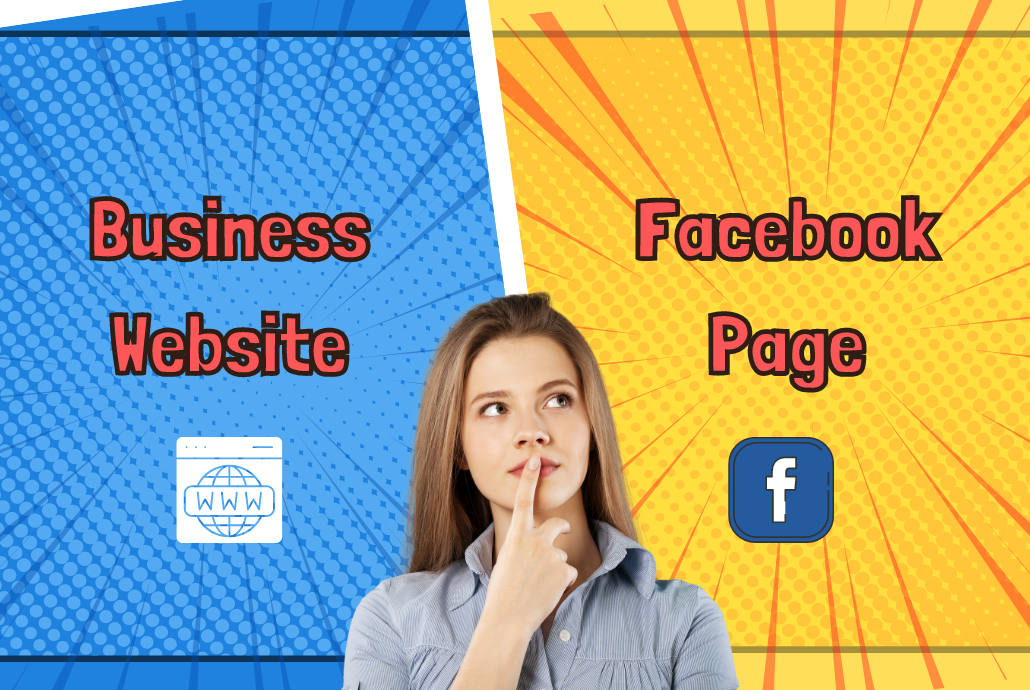
Website vs. Facebook Page

The question comes up more than you’d think. A small B2B company is getting started, or a founder is rethinking their marketing strategy, and the question surfaces: Do we really need a website? We have a Facebook page, a LinkedIn company page, and an Instagram account. Is that enough?
It isn’t. Here’s why, and what the right balance actually looks like.
What a Facebook Business Page Can and Cannot Do
Facebook’s reach is undeniable. Billions of monthly active users, built-in advertising tools, and a low barrier to entry make it an attractive starting point for businesses trying to establish an online presence quickly.
But a Facebook business page is not your platform. It’s a subset of Facebook’s platform, governed by Facebook’s rules, algorithms, and policy decisions. The layout is determined by Facebook. The reach of your posts is determined by Facebook’s algorithm. If Facebook changes its policies, reduces organic reach (which it has, repeatedly), or your account gets flagged or restricted, your entire online presence is affected, and you have no recourse.
For B2B companies specifically, there are three additional limitations worth naming:
Facebook’s audience skews consumer. LinkedIn is the dominant B2B social platform for a reason. Most B2B decision-makers are not using Facebook to research vendors, evaluate services, or discover new solutions. The platform can support brand awareness and retargeting campaigns, but it rarely drives high-intent B2B traffic on its own.
Facebook cannot be optimized for search. A Facebook business page has limited SEO value. It will not help you rank on Google for the keywords your buyers are searching for. It will not surface in AI-generated answers when buyers ask ChatGPT or Perplexity who the best [your service] agency is. Your website can do all of those things. Your Facebook page cannot.
You do not own the data. Every contact, every interaction, every lead that comes through your Facebook page belongs to Facebook’s ecosystem. You cannot export your followers, you cannot own that relationship, and you cannot take it with you.
What a Dedicated Business Website Does That Social Media Cannot
Full Brand Control
Your website is the only place online where you have complete control over how your business is presented. The design, the messaging, the content structure, the user experience, the calls to action, the conversion path. Every element is yours to define and refine. Social media platforms provide you with a profile within their templates. Your website gives you a canvas.
For B2B companies, this matters because your website is often the first place a buyer goes after hearing your name or seeing an ad. What they find there either confirms their interest or ends it. A well-designed, clearly positioned website builds credibility in a way a Facebook page simply cannot replicate.
Search Engine Visibility and AI Search Presence
A properly optimized business website can rank on Google for the terms your buyers search. It can appear in AI-generated answers when buyers ask ChatGPT or Perplexity about solutions in your category. It can earn featured snippets, AI Overview citations, and voice search results. None of that is available through a Facebook page.
Organic SEO and answer engine optimization work because search engines and AI tools index your website content, not your social profiles. If you want to be found when buyers are actively searching for what you offer, your website is the asset that does that work.
Data Ownership and Privacy
When a visitor fills out a form on your website, that contact belongs to you. You can import it into your CRM, segment it, nurture it, and track it through your pipeline. When someone messages your Facebook business page, you are interacting within Facebook’s system under Facebook’s terms.
For B2B companies using HubSpot or any CRM, the website is the hub where marketing and sales data converge. Your forms, your landing pages, your tracking, your attribution. All of it flows through your owned platform.
Credibility and Professionalism
B2B buyers evaluate vendors carefully. A professional, well-structured website signals that your business is established, invested in its brand, and serious about the relationship. A Facebook page alone, regardless of how well-maintained it is, does not convey the same level of credibility.
This is especially true in industries where buyers are making high-value, long-term commitments. They want to see a website that reflects the quality of your work.
Where Facebook (and Social Media Generally) Still Adds Value
None of this means you should abandon social media. For B2B companies, social platforms serve specific and legitimate purposes within a broader inbound marketing strategy.
Facebook advertising remains a cost-effective channel for retargeting website visitors, promoting content, and reaching specific audience segments. LinkedIn is essential for B2B brand visibility, thought leadership, and connecting directly with decision-makers. Instagram and Facebook can support brand awareness campaigns and help humanize your company for buyers who are evaluating you before they reach out.
The key distinction: social media amplifies and supports. Your website anchors. Content you publish on social media should drive traffic back to your website, where you capture leads, build relationships, and connect marketing activity to revenue.
The Right Structure for B2B Online Presence
Think of it as a hub-and-spoke model. Your website is the hub. Social media, paid advertising, email marketing, and AI search optimization are the spokes. Each spoke drives traffic, builds awareness, and creates touchpoints. But all of them point back to the hub, where the real work of converting interest into pipeline happens.
B2B companies that treat social media as a replacement for a website put themselves at the mercy of platforms they don’t control, algorithms they can’t predict, and data they don’t own. B2B companies that build their own platform first and use social media to amplify it are in a fundamentally stronger position.
Ready to build a website that actually converts?
Talk to the Ariad team about web development and growth-driven design, or grade your current website for free to see where you stand today.





Leave a Reply
Want to join the discussion?Feel free to contribute!