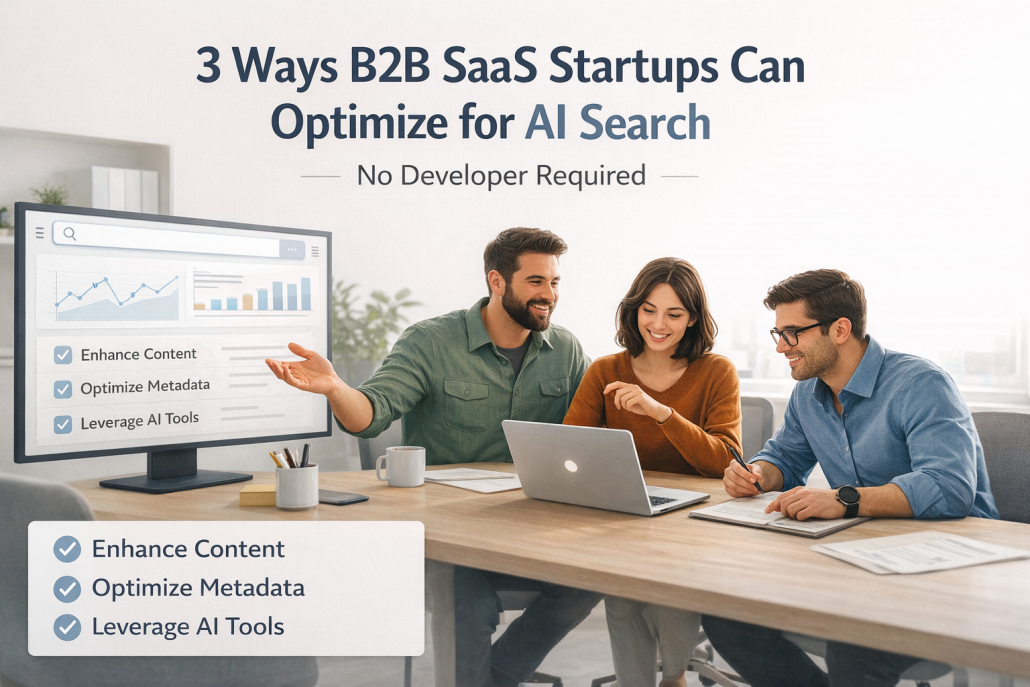
3 Ways B2B SaaS Startups Can Optimize for AI Search — No Developer Required

Something shifted in how your buyers find you. It didn’t happen all at once. But over the past 18 months, a growing percentage of B2B research now starts with a question typed into ChatGPT, Perplexity, or Google’s AI Overviews, rather than with a keyword search and a list of blue links.
For B2B SaaS startups, that shift is both a threat and an opening.
It’s a threat if your content was built solely for traditional SEO. It’s an opening if you move now, before your competitors realize the rules have changed. AI visibility starts with the fundamentals: working with an organic SEO consultant to get the technical and content foundation right is what makes AI citation possible.
AI search doesn’t rank pages. It cites sources. The question is whether your content is structured to be one of them.
The good news: you don’t need a developer to start. These three Answer Engine Optimization (AEO) moves are tactical, implementable this week, and designed specifically for early-stage SaaS teams who are resource-constrained but growth-focused.
#1 Write Definitions That Your Buyers Are Already Asking AI to Explain
Here’s what most SaaS content misses. AI engines like ChatGPT, Perplexity, and Google’s AI Overviews are constantly fielding questions like “what is [your category]” and “how does [your solution] work.” They pull answers from pages that answer those questions directly, clearly, and without burying the lead.
Most SaaS blog posts do the opposite. They warm up slowly, tell a story, and get to the definition three paragraphs in. AI engines don’t wait.
What to do: Add a definitional paragraph to your highest-traffic pages. Open with a single, citable sentence that defines what your product category is and what it does.
Example: If you sell project management software for remote engineering teams, your page should open with something like: “[Product] is a project management platform built for distributed engineering teams, designed to reduce sprint friction, improve async communication, and give engineering leads visibility across every active build.” That sentence is structured to be cited. It names the category, the audience, and the outcome.
One sentence. Placed at the top. No preamble.
This is the single highest-leverage change you can make to existing content. No new pages, no technical changes, no developer.
#2 Add an FAQ Section to Every Core Service or Feature Page
AI Overviews and featured snippets run on questions. The more directly your content answers specific, high-intent questions, the more likely it is to surface when buyers ask those questions to an AI.
For B2B SaaS startups, the questions your buyers are already typing into AI tools look like this:
- What is the difference between [your category] and [competitor category]?
- How long does it take to implement [your type of software]?
- Does [your tool] integrate with [common tool in their stack]?
- Is [your category] right for a company our size?
- What does [your product] cost for a team of 25?
These aren’t blog topics. They’re objections and evaluation questions, exactly what a buyer asks when they’re close to a decision.
Every unanswered buyer question is a citation opportunity you’re leaving for a competitor.
What to do: Add an FAQ section to your pricing page, your features page, and your homepage. Use real questions, pulled from sales call notes, support tickets, or G2 and Capterra reviews. Write concise, direct answers of 2 to 4 sentences each.
In your CMS, this is a text block. In WordPress, it’s an Accordion element. No developer needed.
Once the FAQ content is live, add FAQPage schema markup using a free plugin such as Yoast SEO or Rank Math. That tells Google and AI engines exactly what to do with the content. It becomes machine-readable, not just human-readable.
#3 Get Cited Where AI Engines Are Already Looking
This one surprises most SaaS founders. AI engines don’t just crawl your website. They are trained on, and continue to pull from, third-party sources: G2, Capterra, TechCrunch, industry newsletters, LinkedIn articles, and niche community forums.
Your brand’s presence on those platforms directly affects whether AI cites you.
Think of it this way. When Perplexity answers the question “what’s the best project management tool for remote engineering teams,” it’s synthesizing signals from review sites, comparison pages, editorial coverage, and community mentions, not just your homepage.
If your brand exists only on your website, AI engines treat you as an unknown entity. Third-party citations are what build trust with the machine.
What to do: Start with three actions this week:
- Claim and fully complete your G2 and Capterra profiles. Include a clear category definition, ideal customer profile, and key differentiators in the description fields
- Publish one LinkedIn article (not a post, but a full long-form article) that addresses a top buyer question in your category. LinkedIn content is indexed and cited by AI engines at a higher rate than most SaaS teams realize
- Find two or three industry newsletters or Substack publications where your buyers spend time and pitch a guest contribution: one article with a clear author bio and a link back to your site
None of these requires a developer. All of them build the third-party citation footprint that AI engines use to determine whether your brand is a credible source. This is also the foundation of Generative Engine Optimization (GEO), the discipline of earning placement inside the answers generative AI models produce.
The Compounding Effect of Doing All Three
Each of these tactics works independently. But the real leverage comes when they work together.
Your definitional content gives AI engines something to cite. Your FAQ section addresses the evaluation-stage questions buyers ask. Your third-party citations confirm to AI that your brand is a credible, recognized source in your category.
Together, they create what AI engines are looking for: a brand that is clearly defined, consistently described, and corroborated by sources beyond its own website.
That’s the new visibility equation for B2B SaaS. Not just rankings. Citations.
If your SaaS company needs a partner to build and execute this system, learn more about Ariad Partners’ SaaS inbound marketing services. For a deeper look at how answer engine optimization works across every stage of the buyer journey, explore Ariad Partners’ AEO services.
Start With One Page This Week
Pick your highest-traffic feature or solution page. Add a definitional opening sentence. Add five FAQ questions with direct answers. Make sure your G2 profile is complete.
That’s it. Three changes, one page, this week.
Then repeat for the next page. And the next. AI search visibility isn’t built in a single sprint. It compounds over time, the same way SEO does. The difference is that the window to build early authority is open right now, and for most SaaS startups, it won’t stay open long.
The B2B SaaS companies that show up in AI search answers six months from now are the ones making these changes today.
Ariad Partners helps B2B companies build AI search visibility as part of a broader inbound marketing strategy. Start with a free AI Visibility Audit to see where you stand.
Frequently Asked Questions About AI Search Optimization for B2B SaaS
What is AI search optimization for B2B SaaS?
AI search optimization for B2B SaaS is the practice of structuring your content, schema markup, and third-party presence so that AI-powered search tools, including Google AI Overviews, ChatGPT, and Perplexity, surface your brand when buyers ask questions related to your product category. It combines answer engine optimization (AEO), generative engine optimization (GEO), and traditional SEO into a unified visibility strategy.
How is AI search optimization different from traditional SEO?
Traditional SEO focuses on ranking in search results. AI search optimization focuses on being cited inside AI-generated answers, where buyers increasingly get information without clicking any links. Both matter, but they require different content structures. AI engines prioritize direct answers, clear definitions, and corroborating third-party citations over keyword density and backlink volume alone.
Can a B2B SaaS startup optimize for AI search without a developer?
Yes. The three highest-impact tactics, adding definitional content, creating FAQ sections with schema markup, and building third-party citations on platforms like G2, Capterra, and LinkedIn, can all be implemented directly in your CMS or on external platforms without any developer involvement. Plugins like Yoast SEO and Rank Math handle schema markup with no coding required.
How long does it take to see results from AI search optimization?
Pages with strong existing authority can begin appearing in AI-generated answers within 30 to 60 days of adding proper definitional content and FAQ schema. New content typically takes 60 to 120 days. Building third-party citation authority is a longer-term effort that compounds over 6 to 12 months, similar to how domain authority builds in traditional SEO.
What platforms should B2B SaaS startups prioritize for AI search visibility?
Start with Google AI Overviews, which affect the largest volume of B2B searches. Then focus on Perplexity, which is growing rapidly among technical and research-oriented buyers. ChatGPT and other conversational AI tools draw on web content and trained datasets, so strong editorial coverage on G2, Capterra, LinkedIn, and content surfaced through Reddit keyword research all contribute to visibility across those platforms.


Leave a Reply
Want to join the discussion?Feel free to contribute!