Manufacturing Marketing Strategy

A manufacturing marketing strategy built on inbound attracts industrial buyers through search-optimized technical content, educational resources, and AI search visibility instead of cold outreach. Because manufacturing buyers finish most of their research before they ever contact a supplier, inbound puts your company in front of them during that research phase, so you’re found, evaluated, and shortlisted before your sales team even knows the opportunity exists.
As a B2B manufacturing marketing agency, Ariad Partners has seen how well this model fits manufacturers in particular. Long sales cycles, technical buying committees, and high-consideration purchases are exactly the conditions in which inbound marketing outperforms interruption-based marketing, and inbound marketing for industrial manufacturers is no exception. Here’s how to make it work.
Manufacturing buyers changed how they buy
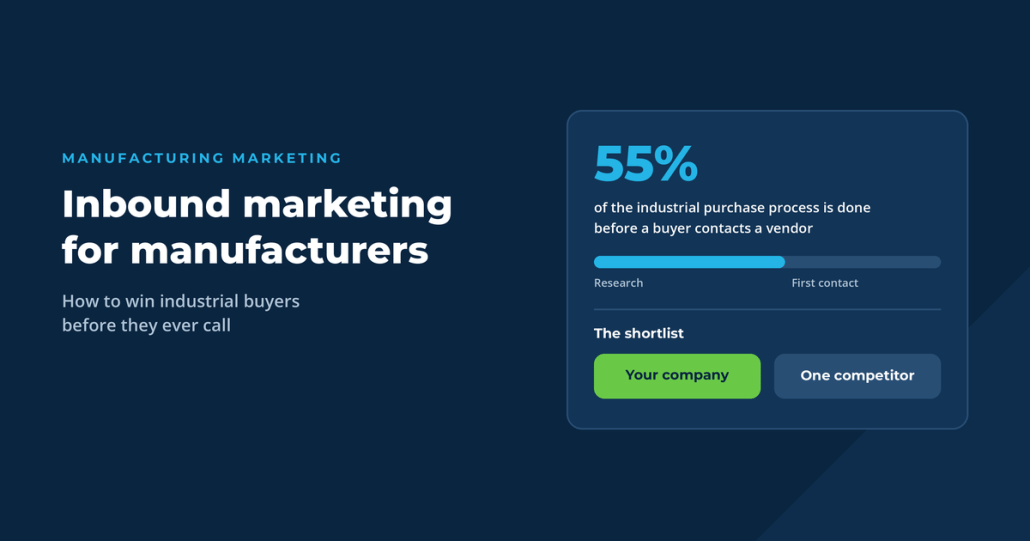
The 2025 Industrial Buying Influence survey from Gardner Business Media found that more than 55% of the industrial purchase process is completed before a buyer contacts a vendor. The same research found that 68% of buying teams evaluate a list that combines previous suppliers with new ones they’ve found through their own research, then narrow it to a shortlist of just two (yes, two), which means the shortlist is already set by the time your sales team receives an inquiry. If your company wasn’t findable during the research stage, you were never really in the running.
This pattern runs across B2B, too. Gartner’s 2025 sales survey found that 61% of B2B buyers prefer a rep-free buying experience, favoring digital self-service for research and evaluation. And the engineers, plant managers, and procurement leads who buy from manufacturers are among the most research-driven buyers in any industry; they read spec sheets, compare tolerances, and check lead times long before they fill out a contact form.
Why inbound fits long industrial sales cycles
Manufacturers often dismiss content marketing because a blog post doesn’t close a six-figure equipment deal. That’s true as far as it goes, but it misses what inbound actually does. Inbound marketing rarely gets credit for the last touch before a purchase order, yet it’s usually the reason your company made the shortlist in the first place.
Three characteristics of industrial sales make inbound especially effective:
- Long consideration windows. A capital equipment or component purchase can take months to go from problem identification to PO. Content keeps your company visible throughout that entire window, while a cold call only works if it lands at exactly the right moment.
- Multiple stakeholders. Engineers, operations leaders, procurement, and finance all evaluate different criteria, and a content library lets each find the answers they need on their own, from technical specifications to total cost of ownership.
- Project-driven demand. Many industrial purchases are triggered by a specific project or customer requirement you can’t see coming. You can’t time outreach to a trigger you can’t see, but search-optimized content is already waiting whenever that trigger fires.
Marketing for manufacturers: content that’s citation-worthy
Generic marketing content falls flat with industrial buyers. The content that earns a spot on the shortlist is specific, technical, and focused on real applications:
- Application case studies. Show a real problem, the constraints, the solution, and measurable results; industrial buyers trust proof over promises.
- Technical FAQ and specification content. Answer the questions engineers actually ask: material compatibility, tolerances, certifications, lead times, and minimum order quantities. These pages tend to rank for high-intent, long-tail searches with very little competition.
- Comparison guides. Content built around “X vs. Y” searches, comparing processes, materials, or approaches, catches buyers while they’re actively weighing their options.
- Cost and ROI explainers. Buying committees include non-technical members, so content that helps a procurement lead or CFO understand lifetime cost, maintenance, and ROI supports the internal sale your champion has to make.
Each of these formats also feeds into a broader inbound marketing strategy built on topic clusters: a comprehensive pillar page supported by focused articles that together establish your authority in your niche.
Manufacturing lead generation: turning research into inquiries
Getting found is only half the job; manufacturing lead generation is about giving a researching engineer or procurement lead a reason to raise their hand before they’re ready to request a quote. That means offering something useful at each stage of their research and making the next step easy, without forcing a sales conversation too early.
- Spec sheets and CAD files. Engineers want these anyway, so a short form in front of the downloads tells you which companies are evaluating you (and for which applications).
- RFQ forms that ask the right questions. Material, quantities, tolerances, and timelines up front save your sales team from a round of back-and-forth and help you spot serious inquiries quickly.
- Application guides and checklists. These work well as gated resources for people on the buying team who aren’t engineers, such as procurement and operations.
- Nurture email for long cycles. A buyer who downloads a spec sheet in March might not have budget until fall, so a light email sequence keeps you on the shortlist while the project waits.
Tie every form to your CRM so you can see which content turns into real opportunities, and judge the results over quarters rather than weeks.
Inbound marketing integrations for manufacturing companies
Inbound works best when your marketing tools talk to the systems your sales and operations teams already use. For most manufacturers, that means connecting a few key pieces:
- CRM and marketing automation. A platform like HubSpot captures form fills, tracks which content each contact reads, and runs nurture email across long buying cycles.
- ERP. Syncing customer and order data with marketing shows which campaigns turn into real orders, and it keeps you from nurturing a company that’s already a customer.
- RFQ and quote tools. Routing RFQ submissions straight into your CRM means sales sees the request along with the research history behind it.
- Website forms and gated downloads. Spec sheets, CAD files, and application guides should all feed the same contact record, so nothing gets lost in someone’s inbox.
If you’re running HubSpot (or thinking about it), Ariad Partners’ HubSpot solutions cover the setup and integrations that make this work.
AI search is now the front door
The biggest year-over-year shift in the 2025 Industrial Buying Influence data involves AI. The share of industrial buyers who picked AI Overviews as one of their top two preferred search results jumped from 8% in 2024 to 26% in 2025, the largest single-year gain of any data point in the survey’s history (Gardner Business Media).
So roughly one in four industrial buyers now starts research in an AI-generated answer before they ever look at a list of blue links. If AI systems can’t find, parse, and cite your content, you’re invisible at the very start of the buying journey.
Optimizing for AI search (you’ll also hear it called answer engine optimization, or AEO, and generative engine optimization, or GEO) builds on the same foundation as strong organic SEO, plus a few specifics: direct-answer sentence structures, clear entity definitions, FAQ content with schema markup, and clean semantic HTML that AI crawlers can extract.
A first-quarter marketing plan for manufacturing companies
Most SMB manufacturers don’t have a marketing team, and you don’t need one to get started with inbound. A practical first-quarter plan looks like this:
- Audit what you have. Inventory your existing content, check what already ranks in Google Search Console, and identify your highest-value keyword gaps. (Our guide to SEO KPIs covers which numbers to watch.)
- Fix the technical foundation. Site speed, mobile usability, schema markup, and clean page structure determine whether anything else works.
- Publish two to four cornerstone pieces. Start with the questions your sales team answers most often; if they’re hearing those questions, buyers are searching for them too.
- Add FAQ sections with schema to your core product and service pages so both Google and AI systems can pull direct answers from them.
Consistency beats intensity here; a steady publishing cadence built around real buyer questions will outperform a one-time content blitz every time. Prefer to have it built for you? See how our manufacturing marketing agency runs the program end-to-end.
Ariad Partners is a woman-owned B2B inbound marketing agency and HubSpot Partner, helping SMBs grow through SEO, content marketing, and AI search visibility since 2011. If you want to see exactly where your company appears in AI search (and where your competitors show up instead), get a free AI visibility audit.