AI search visibility: where your budget actually belongs

Most small and mid-sized businesses don’t have an AI visibility problem. They have a pipeline problem, and there’s no AI visibility score they can chase that’s going to fix it. As an agency that sells AI search optimization services, I can say two things are true at once:
- AI search is real, it’s growing fast, and it will matter more every quarter.
- And most businesses currently worried about their AI visibility score would drive more sales by refocusing on their inbound marketing program.
The key is admitting which one you are.
Everything is selling you AI
Before the data, let’s talk about what you’re actually experiencing.
Open LinkedIn and count how many of your first ten posts are about AI search. Scroll Facebook and watch the ads promising to tell you what ChatGPT says about your brand. Check your inbox for the cold email offering a free AI visibility audit. Sit through a webinar and wait for the slide where traditional SEO gets declared dead.
Ariad Partners sells AI search visibility. We’ve written about it, published on it, and made money selling it. But saturation isn’t evidence of necessity. It’s evidence of a category with funding behind it and a short window to sell. Urgency sells software. It doesn’t always reflect your business needs or produce the results you were hoping for.
What the data actually says about AI search traffic
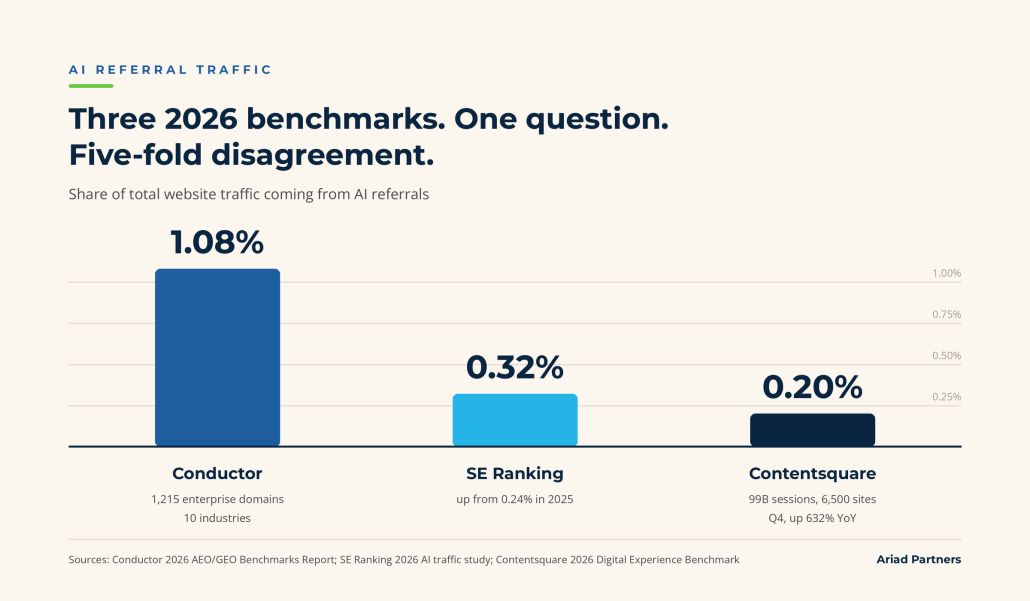
Start with the number everyone quotes. Conductor’s 2026 AEO/GEO Benchmarks Report found AI referral traffic accounts for 1.08% of website traffic on average, growing at roughly 1% month over month, with ChatGPT driving about 87.4% of it. That figure covers 10 industries, and the study’s traffic component drew on 1,215 enterprise domains from the 3.3 billion sessions it analyzed.
Now put that next to the other benchmarks from the same window. Contentsquare’s 2026 Digital Experience Benchmark Report, built on 99 billion sessions across 6,500 sites, puts AI-referred traffic at 0.2% of total visits in Q4, up 632% year over year. SE Ranking’s 2026 study puts it at 0.32%, up from 0.24% in 2025.
Those three numbers disagree by a factor of five.
That’s not a scandal. Different samples, different attribution methods, and a channel so new that nobody has agreed on how to measure it. But it should give you pause the next time someone quotes you a single percentage like it’s settled.
A few caveats matter more than the headline number.
The biggest dataset is the enterprise market. Conductor’s figure comes from enterprise domains across 10 industries. A regional manufacturer with forty people wasn’t in that sample. There’s no reliable public benchmark for what AI referral traffic looks like for an SMB, and for most SMBs right now, the honest answer is a rounding error.
Referral clicks are the wrong thing to watch anyway. The bigger finding in that same Conductor report is that Google AI Overviews now show up in roughly 25% of searches. For most SMBs, that’s your real AI exposure. It isn’t someone asking ChatGPT to recommend a vendor. It’s Google answering the question above your organic listing, on a search you used to win.

Pew Research Center watched the actual browsing behavior of 900 US adults in March 2025 and found people clicked a traditional search result on 8% of visits where an AI summary appeared, against 15% where one didn’t. Only 1% clicked a link inside the summary itself. Worth noting that’s observational; Pew compared two sets of searches, which doesn’t prove the summary caused the drop. But it’s buyer behavior rather than a vendor’s dashboard, and the direction is hard to argue with.
And here’s the part that cuts against what I just told you: referral traffic is a lousy proxy either way. Someone can read about you in an AI-generated answer, close the tab, and then show up in your inbox a week later via a Google search or a referral.
Low AI referral numbers don’t prove AI isn’t influencing your pipeline. They just prove it isn’t sending clicks. The only way to know the difference is to ask your prospects how they found you, which is free and can be included on your contact form.
14 out of 100
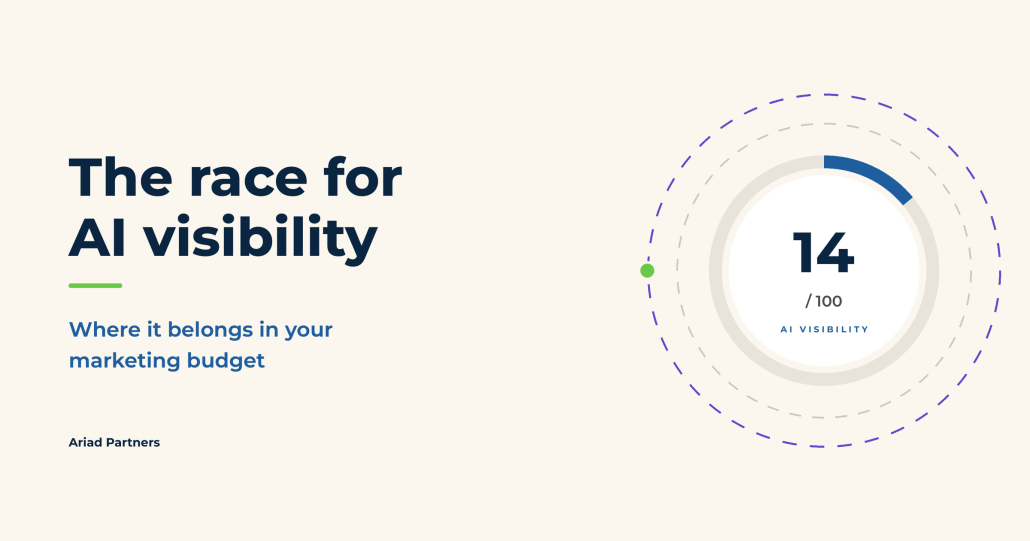
We track our own AI visibility in Semrush across 52 prompts and 46 topics. As of August 2026, the score read 14 out of 100. Low. The tool’s own summary: “rarely mentioned in LLM outputs compared to competitors.”
Across those prompts, our content was cited 51 times across 31 pages. Four weeks later, on September 22nd, 2026, we had 79 citations across 38 pages. Our brand was mentioned twice. That’s more than 50% growth in citations, and our AI visibility score stayed at 14/100.
That gap is the whole story.
Citations and mentions aren’t the same thing, and rolling them into one score hides the difference. A citation means an AI system pulled from your page to build its answer. A mention means it named you. We’re referenced constantly and recommended almost never.
Which makes sense when you look at what produces each one:
- Citations follow content quality and organic rankings: publish something clear and useful on a page that ranks, and AI systems will draw from it.
- Mentions follow brand authority: third-party coverage, reviews, industry conversation, being talked about in rooms you’re not in. That’s why guest posting and earned coverage do work your own blog can’t.
Why AI visibility scores feel more important than they are
An AI visibility score does something psychologically useful. It takes a vague, threatening, hard-to-see shift and turns it into one number that goes up or down. Numbers that go up feel like progress. Dashboards feel like control.
The problem is what that number is made of.
Every AI visibility score on the market is modeled, not measured. No tool knows what your buyers are actually typing into ChatGPT. Tools send their own test prompts to model APIs, record what comes back, and package it. The prompt set and how often it runs shape the score more than your real visibility does. That’s why two tools pointed at the same brand can give you different numbers.
Then there’s the stability problem, which comes from academic research rather than vendor marketing. Schulte, Bleeker and Kaufmann’s April 2026 study ran identical prompts repeatedly across ChatGPT, Gemini, Google AI Mode and Perplexity. Cited sources overlapped between consecutive days by only 34%-42%. Brand mentions held up a little better, at 45%-59%.
Read that again. Ask the same question two days running and roughly half the brands in the answer change.
Their conclusion: AI visibility is a distribution, not a score. Check once, and you don’t appear; that’s not evidence of a problem. Check once, and you do; that’s not evidence of success. A single reading is closer to a coin flip than a measurement.
The structural problem nobody selling these tools leads with
The same research points at something harder.
AI search is winner-take-most. Schulte and colleagues measured citation concentration with the Gini coefficient and found an average of 0.715 across platforms, rising to 0.782 for Google AI Mode. Plain version: a small group of high-authority domains soaks up most of the citations.
SE Ranking’s analysis of 2.3 million pages across 295,000 domains found the same thing from the other side. Domain traffic was the strongest single predictor of whether a page would earn a citation in Google AI Mode, and high-traffic sites earned roughly three times as many citations as low-traffic sites.
So if you run a regional professional services firm with a modest domain, and the plan is to buy a GEO tool and start writing prompt-shaped content, that tool will dutifully report a low score every month while the real constraint sits somewhere else.
You’re not losing citations because your headings are formatted wrong. You’re losing them because you haven’t built the authority signals these systems lean on as a proxy for trust, and that’s organic SEO work more than it is AI work.
“Inbound is a marathon, not a sprint.”
It’s my favorite thing to say on a sales call. It sets the narrative, and it happens to be true. Building those signals is slow work: earning mentions on sites your buyers already read, publishing things worth citing, collecting reviews, showing up where your industry talks, investing in your website with evergreen content that doesn’t disappear when someone clicks.
You don’t have to take my word for it. Google’s own guidance on AI features says the SEO practices you already know still apply to AI Overviews and AI Mode, and that there’s no special AI optimization required to be eligible. Being eligible isn’t the same as being included, and this is Google talking about Google, not a rule for every platform. But the company running the surface that matters most to SMBs is telling you to do the work you were already supposed to be doing.
AI search visibility is exactly inbound marketing. The discipline didn’t get replaced. It got a new output surface.
What the buyer data actually shows
Wynter surveyed 101 mid-market B2B SaaS CMOs in January 2026 and found 84% now use AI or LLMs to find vendors, with 68% starting their research in AI tools before traditional search. Two years earlier, that number was close to zero. That’s not a trend you get to wave off, and if you sell to that audience, this section is your cue to move AI visibility up the list.
But the same survey found something else. When asked what gets a vendor into the consideration set, 42% ranked word of mouth first. Paid ads and cold outreach tied for last at 2% each. And 65% start their vendor search inside peer communities, the private Slacks and forums you can’t buy your way into.
So AI took the top of the funnel. It didn’t take the trust. Buyers use AI to find options and their peers to decide between them.
Worth saying plainly: that’s 101 SaaS CMOs, not a cross-section of SMBs. Treat it as directional, not as your market. But its shape holds up against everything else we see, and it’s the argument for building trust and authority rather than chasing a score:
The businesses AI recommends are the ones people already talk about.
The inbound fundamentals that still move the needle
The flywheel doesn’t care which surface delivered the first impression. It cares whether you attract the right people, convert them efficiently, and turn customers into the referrals that start the next cycle. Inbound methodology handles this.
Here’s where that effort usually pays off for an SMB.
Attract
- Bottom-funnel organic search. The queries people run when they’re ready to buy. Less exposed to AI Overviews than informational queries, usually less competitive, and they still convert.
- Content that answers what buyers actually ask. Not keyword pages. The specific objections and comparisons that come up on your sales calls. This is also the content that earns AI citations, which is the point. Content marketing and AEO are the same job done well.
- Local and industry presence. Google Business Profile, consistent listings, trade associations, the places your buyers already look.
Convert
- A site that converts the traffic you already have. Before chasing new discovery surfaces, find out what percentage of qualified visitors actually take an action. It’s almost always lower than you’d guess.
- Speed to lead. If a form fill sits for two days, no amount of AI citations or mentions will fix it. It’s the cheapest pipeline improvement available to nearly every business we look at.
- Email to the list you already own. Segmented, useful, and with no algorithm sitting between you and the inbox.
Delight, then repeat
- Referrals, made systematic. Ask at the moment of highest satisfaction, make the introduction easy, and track it like a channel.
- Proof. Case studies, named results, reviews, third-party validation. This carries the weight for referrals, sales conversations, organic search, and AI citation. Our own client results are the asset we point to most often.
- Attribution you trust. You can’t prioritize anything if you can’t see where your pipeline comes from.
Go back to number eight. The best AI visibility asset most SMBs can build is a solid case study library, and it’s working for you four other ways before an AI system ever cites it. That’s the test for anything you’re thinking about funding: does it still move the needle if AI search never pans out?
When to prioritize AI visibility, and when not to
None of this is an argument for ignoring AI search. It’s an argument about sequencing.
When to invest in AI search optimization:
- Your buyers are early adopters. IT services, B2B SaaS, and technology show the highest AI referral traffic across all datasets, with IT at 2.80% in Conductor’s analysis, compared to an average of 1.08%. If you sell software to CMOs, the Wynter numbers above are about you.
- You rank well, and your clicks are falling. If Search Console shows impressions holding while clicks drop on informational queries, AI Overviews are taking that traffic, and restructuring the content is a direct fix.
- You have a long, research-heavy sales cycle. The more your buyers research before they contact you, the more the AI layer shapes your shortlist.
- Your inbound fundamentals are already solid. If referrals are systematic, the site converts, and organic traffic is healthy, AI visibility is a reasonable next frontier rather than a distraction.
- You’re the clear specialist in a narrow niche. Being an unmistakable expert in a defined category is one of the few things that reliably gets a smaller brand cited.
When to wait:
- Your site is new, or it converts poorly. Sending more traffic to a page that doesn’t convert just makes the leak bigger. Find out what share of your qualified visitors actually take an action, then fix that path. It’s the cheapest pipeline win most SMBs have sitting in front of them.
- Your organic presence is thin. Go after the bottom-funnel queries first, the ones people type when they already know they need to buy. Less competitive, less exposed to AI Overviews, and they convert.
- You can’t attribute your pipeline today. Everything above is a guess until you can see where deals come from. Fix the tracking before you fund anything new.
Fix those first. The results compound, and build the exact authority signals AI systems reward. None of it is a detour from AI visibility. It’s the starting line.
Why we’re telling you this
Ariad Partners is a woman-owned, inbound marketing agency helping B2B SMBs grow since 2011. And AI search visibility is one of our services.
But selling a monthly AI optimization retainer to a business that doesn’t show up on Google SERPs isn’t consulting. Neither is selling one to a company that hasn’t published original content in years, let alone anything worth citing. Ariad Partners was built to meet clients where they are, not where the market says they should be.
The race for AI is real. It just isn’t the only race worth running, and for most small and mid-sized businesses it isn’t the one where next quarter’s pipeline gets won.
Not sure which one you are?
That’s the question worth answering before you move any budget. We’ll look at where you actually stand in AI search, what’s driving it, and whether it’s where your next dollar should go. If the answer is no, we’ll tell you that, too.
Sources
- Conductor, 2026 AEO/GEO Benchmarks Report (13,770 domains, 3.3 billion sessions; referral traffic figure drawn from 1,215 enterprise domains across 10 industries)
- Contentsquare, 2026 Digital Experience Benchmark Report (99 billion sessions, 6,500 sites, Q4 2024 vs Q4 2025)
- SE Ranking, AI traffic research study, 2026 (0.32% referral traffic figure)
- SE Ranking, AI Mode citation study, 2025 (2.3 million pages, 295,000 domains)
- Schulte, J., Bleeker, M., & Kaufmann, P. (2026). Don’t Measure Once: Measuring Visibility in AI Search (GEO). arXiv:2604.07585
- Wynter, survey of 101 mid-market B2B SaaS CMOs, January 2026
- Pew Research Center, Google users are less likely to click on links when an AI summary appears in the results, July 22, 2025 (observational analysis of March 2025 browsing data from 900 US adults)
- Google Search Central, AI features and your website, accessed September 2026


Leave a Reply
Want to join the discussion?Feel free to contribute!