How AI Search Optimization Tools Increase Organic Traffic

AI search optimization tools increase organic traffic by showing you where your business appears in AI-generated answers, identifying why competitors get cited when you do not, and pointing to the specific fixes that improve your visibility. They turn AI search from a black box into something you can measure and act on, which is what makes the traffic gains possible. The tools do not generate traffic on their own. They tell you what to change so your content earns more visibility across both AI answers and traditional search.
If you can’t see how your business shows up in ChatGPT, Gemini, or Google AI Overviews, you can’t improve it. That visibility is the first thing these tools give you, and it is where the organic traffic gains start.
What AI Search Optimization Tools Actually Do
AI search optimization tools, sometimes called GEO tools or AI visibility tools, monitor how your business appears inside AI-generated answers and help you improve that presence. Traditional SEO tools track where your pages rank in search results. AI search optimization tools track something different: whether AI engines mention, cite, and recommend your business when buyers ask questions. (For the bigger picture of how this fits together, see our guide to what AI search optimization is.
Most tools in this category do some combination of four things.
- Track your visibility across AI engines like ChatGPT, Perplexity, Gemini, and Google AI Overviews
- Analyze which sources those engines cite, so you can see who is winning the answers you want
- Benchmark you against competitors
- Offer recommendations on what to fix, from content structure to the gaps that keep you from finding answers
The connection to organic traffic is direct. AI search is becoming a primary way buyers research and discover businesses. The tools show you where you stand in that channel and what to change; acting on them grows your visibility and traffic over time.
How AI Search Optimization Tools Increase Organic Traffic
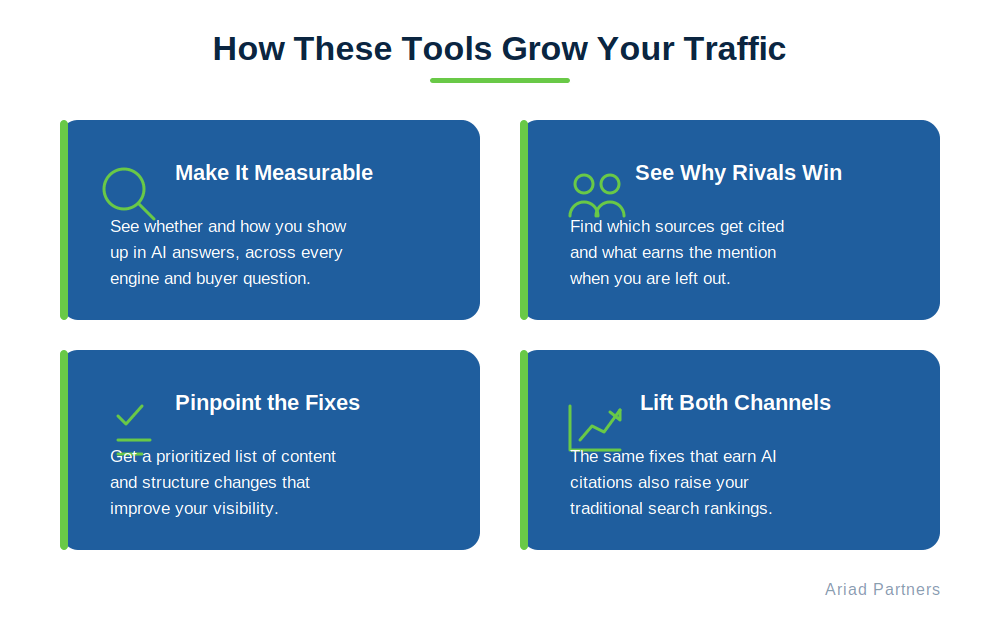
The traffic gains come from four mechanisms, each tied to something the tools make visible.
1. They Make AI Visibility Measurable
You cannot improve what you cannot see. The core function of these tools is to show you whether and how your business appears in AI answers, across engines, and across the questions your buyers actually ask. That baseline turns a guessing game into a measurable channel. Once you can see which questions you show up for and which you do not, you know exactly where the opportunity is.
2. They Reveal Why Competitors Get Cited
Most AI search optimization tools analyze the sources that AI engines cite when answering a question. If a competitor gets mentioned and you do not, the tool helps you see why: which pages the engine pulled from, what content earned the citation, and how that business is represented online. That competitive insight tells you what to build. (If you are not appearing at all, our guide on [why your website doesn’t appear in AI search results](https://ariadpartners.com/why-website-not-in-ai-search/) covers the most common causes.)
3. They Identify the Specific Fixes
The better tools go past measurement into recommendations. They surface content gaps, structural problems, and visibility issues that are holding you back and prioritize them by impact. Instead of optimizing blindly, you get a focused list of changes that improve your chances of being cited and, in turn, your traffic.
4. The Same Fixes Improve Traditional SEO Too
This is the part that compounds. The changes these tools recommend- clearer structure, direct answers, stronger entity signals, and better content depth- are the same fundamentals that improve traditional search rankings. So the work you do to earn AI citations also tends to lift your organic rankings, and you gain traffic from both channels at once.
Do AI Search Optimization Tools Improve SERP Rankings?
Indirectly, yes. The tools themselves do not change your rankings. What they do is reveal the content and structural improvements that help on both fronts. Because AI search and traditional search share fundamentals, indexable content, clean structure, and strong entity signals, the fixes these tools recommend frequently improve your standing in the traditional results page as well as in AI answers. The ranking gains come from acting on what the tools surface, not from the tools alone.
Does AI Content Optimization Improve Search Visibility?
Yes, when it is done on the fundamentals rather than tricks. Optimizing content for AI search means making it clearer, better structured, more directly useful, and easier for engines to extract and attribute to the right sources. Those qualities improve visibility across AI answers and traditional search simultaneously, because both reward content that is genuinely useful and well-organized. AI content optimization improves visibility by strengthening the substance and structure of your content, not by trying to game the engines.
The Main Types of AI Search Optimization Tools
The category is young and crowded, and tools fall into a few rough groups. Knowing the types helps you choose what fits a B2B SMB.
- Visibility tracking and monitoring tools focus on measuring where your brand appears across AI engines. Peec AI is a widely used option oriented toward small and mid-sized marketing teams, and Otterly AI and LLMrefs are other monitoring-focused tools, with LLMrefs aimed at smaller teams and solo marketers. These are good entry points when your first goal is simply seeing your AI visibility.
- Enterprise GEO platforms offer deeper analytics, broader engine coverage, and security and compliance features for large organizations. Profound and Scrunch AI sit in this group. They are powerful and generally more than a small business needs, but they are worth knowing as the high end of the category. AthenaHQ is another in the broader GEO space, oriented toward growth-stage and mid-market companies.
- All-in-one and content-execution tools combine visibility tracking with content creation or optimization workflows. Scalenut and Writesonic fall into this category, pairing AI search features with content production. Bluefish is another platform in the GEO space oriented toward larger brands.
- Traditional SEO suites with AI features have added AI search tracking to their existing platforms. Semrush, Ahrefs, and SE Ranking all now include some AI visibility capability, which can be convenient if you already use one of them.
A note before you choose: this category changes fast, and features, coverage, and pricing shift constantly. Treat the groupings above as a starting map, not a final verdict, and verify current capabilities directly with each tool before committing.
How to Choose a Tool as a B2B SMB
You do not need the most powerful platform. You need the one that fits your stage. For most B2B SMBs starting out, a focused visibility tracker answers the first and most important question: are we showing up in AI answers at all, and if so, for what? If you already pay for an SEO suite with AI features, start there before adding another subscription. Move to a more capable platform only when you have a clear reason, like managing visibility across many pages or clients.
The tool matters less than the habit. The businesses that gain traffic are the ones that measure their AI visibility, act on what they learn, and recheck regularly, whatever tool they use.
Where Ariad Partners Fits
If you want to see where you stand before committing to a paid platform, Ariad Partners offers a free AI Visibility Score tool as part of our SEO tools hub, so you can get a baseline read on your AI search presence at no cost.
For businesses that would rather not manage the tools and the optimization work themselves, that is the service side of what we do. As a B2B inbound marketing agency, Ariad Partners has helped SMBs grow through SEO, content marketing, and AI search visibility since 2011. We use tools like these alongside hands-on strategy to improve where our clients show up across AI answers and traditional search.
The Honest Limits
AI search optimization tools are useful, but they are measurement and guidance, not magic. No tool guarantees traffic, and none can directly control what an AI engine says about you. AI citation patterns shift frequently, so a single snapshot matters less than the trend over time. Treat these tools as instruments that tell you where you stand and what to try, and judge any tool against your actual needs rather than its marketing.
The traffic gains are real, but they come from consistently acting on what the tools reveal over time. The tool is the dashboard. The work is still the work.
Frequently asked questions
How do AI search optimization tools increase organic traffic?
Do AI search optimization tools improve SERP rankings?
Does AI content optimization improve search visibility?
What are AI search optimization tools?
Which AI search optimization tool is best for a small business?
Do I need a paid tool to improve my AI search visibility?
Ariad Partners
As a B2B inbound marketing agency, Ariad Partners helps SMBs grow through SEO, content marketing, and AI search visibility since 2011. If you want to know where your business stands in AI search and what to fix first, we can help.
Free AI visibility audit
Is your business showing up when buyers ask AI?
See how ChatGPT, Perplexity, and Google AI Overviews describe your business compared to competitors, with a prioritized fix list. Free for B2B SMBs, delivered in 5 business days.


Leave a Reply
Want to join the discussion?Feel free to contribute!