
Entity SEO: What It Is and How to Do It for B2B

Entity SEO is the practice of optimizing your site around clearly defined things (your company, your people, your services, the topics you own) and the relationships between them, instead of around isolated keyword strings. Search engines and AI answer tools increasingly work this way. If they can tell exactly who you are, what you sell, and which topics you’re credible on, you’re easier to rank, cite, and recommend.
This guide explains what an entity is, how Google identifies one, and the practical steps a small- or mid-sized B2B company can take to build its own. It also covers what results to expect, because the honest answer is more useful than a big promise.
Ariad Partners
Make Your Brand Easy to Understand
Ariad Partners combines SEO, content marketing, and AI search optimization to help SMBs show up clearly in Google and AI answers.
TL;DR
- An entity is a uniquely identifiable thing, such as a brand, person, product or concept, with a name, a type, attributes and relationships to other entities.
- Keywords are the text people type. Entities are the real-world concepts behind those words, and search systems use them to resolve ambiguity.
- Building your entity means keeping your name, people, services and locations consistent, connecting them with structured data, and covering your topics in depth.
- Entity work supports ordinary SEO rather than replacing it, and it mainly improves how accurately you’re understood and matched to specific searches.
- Start with a clean About page, Organization schema and one canonical entity per page, then expand into topic clusters.
Table of Contents
- What is an entity in SEO?
- How search engines identify entities and use the Knowledge Graph
- What entity building means for a business
- How to optimize for entities: a step-by-step plan
- A worked example: a regional IT provider
- What results can you realistically expect?
- Our perspective on entity SEO
- Where Ariad Partners can help
- A simple entity SEO checklist
- FAQ
- Sources
What is an entity in SEO?
An entity is a uniquely identifiable object or thing, characterized by its names, types, attributes and relationships to other entities. A person is an entity. So is a company, a software product, a city or an idea like “customer relationship management.”
The important point is that an entity isn’t the same as the word that labels it. Search Engine Journal explains that an entity is closer to a database record with an identifier (Google uses machine IDs) than to a phrase. The word “Apple” is a string. Apple the company and apple the fruit are two different entities that happen to share it.
Entities vs. keywords: a quick example
A keyword is the text a searcher enters. An entity is the underlying concept. One HubSpot explainer gives a clean illustration: “best CRM tools” is a keyword, while HubSpot, Salesforce and customer relationship management are entities. Keyword SEO targets the phrase. Entity SEO targets the recognized things and how they connect.
Here’s how that looks for a B2B firm:
| Keyword | Entity | |
|---|---|---|
| What it is | A phrase a buyer types | A defined thing a search system recognizes |
| Example | “managed IT services for law firms” | Your company, “managed services,” “legal industry,” your CEO |
| Optimized by | Matching wording, intent and content depth | Consistent naming, structured data, relationships, topical coverage |
| Fails when | The page doesn’t match the query | The system can’t tell who you are or what you’re about |
You need both. Keywords tell you what buyers ask. Entities tell search systems who is answering.
How search engines identify entities and use the Knowledge Graph
Search engines read text and try to link each mention to a known thing. This step, called entity linking, recognizes entity mentions in text and associates them with entries in a knowledge base. The surrounding context helps machines resolve ambiguity.
Google’s version of that knowledge base is the Knowledge Graph, which launched in 2012. Search Engine Land describes it as structured data about the relationships among people, places, things and concepts: Google’s “things, not strings” approach.
Ambiguity is where this matters most. The same guide notes that a search for “seal” could mean a recording artist, the U.S. Navy SEALs or a semi-aquatic mammal, depending on context. Entities and their relationships are how a search system picks the right one.
Where you see entities in search results
The Knowledge Graph supports features such as Knowledge Panels, rich snippets and local search results. For a B2B company, the most visible payoff is often a brand panel that shows the right logo, description, leadership and profiles. A messier payoff is the opposite: a wrong or missing panel, or a competitor with a similar name taking your space.
Why AI search makes this more relevant
Answer engines and AI summaries need to decide which sources and brands to name when they respond. A brand that’s clearly defined, consistently described and tied to specific topics is easier for those systems to place correctly. That’s why entity thinking sits at the center of answer engine optimization (AEO) and generative engine optimization (GEO). Our B2B SEO guide for Google and AI search covers how the two fit together.
What entity building means for a business
Entity building is the deliberate creation and connection of your company’s identity, people, products, services, locations, categories and topics. Done well, those relationships tell search systems what you offer, where you operate, who provides it and which subjects you belong to, which reduces ambiguity.
Search Engine Journal puts it in graph terms: entity optimization connects owners, products, office address and blog authors to the brand’s main node, forming a web of related data points. Your company is the hub. Everything else is a spoke that confirms who you are.
For a B2B SMB, the hub-and-spoke map usually includes:
- The organization: legal name, brand name, logo, founding details, location
- The people: founders, executives and authors who publish under your brand
- The offerings: each service or product, described the same way everywhere
- The topics: the subjects you want to be known for, such as “inbound marketing for IT providers”
- The audiences and places: industries served, regions served
How to optimize for entities: a step-by-step plan
You don’t need a research lab. You need consistency, structure and depth. Roll up your sleeves and work through these steps in order.
1. Define your core entities on paper
Write one sentence for each: who you are, what you sell, who you sell to, and the three to five topics you want to own. Then list the exact names you use. If your company appears as “Acme Co.,” “Acme Consulting,” and “ACME” across the web, pick one and standardize it. This is the cheapest and most overlooked step.
2. Make your About page and key pages unambiguous
Your About page should state plainly what the company is, where it operates, who leads it and what it does. Do the same for each service page. Use the same naming and descriptions you defined in step 1.
For each page, align the title, H1, and the schema mainEntityOfPage around one canonical entity. A page that tries to be about five things gives search systems five reasons to be unsure.
3. Add structured data that connects the dots
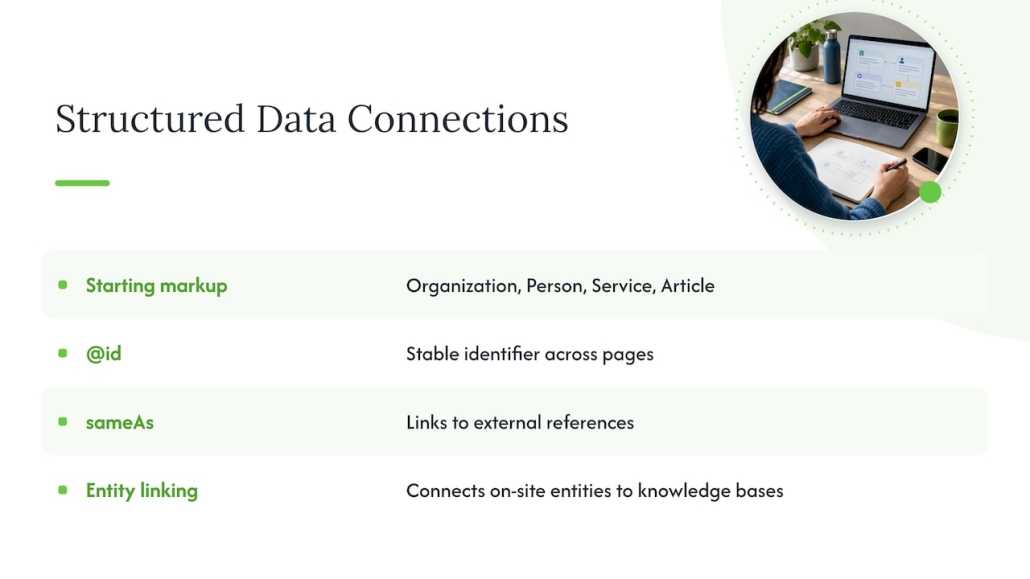
Schema markup is how you state entities and relationships in a machine-readable way. Start with Organization, Person (for leadership and authors), Service and Article markup.
Two details matter. Search Engine Land recommends using @id consistently, because Google evaluates schema page by page, so a stable identifier lets you reference the same entity across pages. And the sameAs property can link your entities to external references such as Wikidata or Wikipedia. For most SMBs, sameAs will point to your LinkedIn page, Crunchbase-style profiles and other official profiles you control.
This kind of work is called entity linking when you extend it to the topics you mention: connecting on-site entities to authoritative external knowledge bases using properties such as sameAs, mentions and areaServed.
4. Map important entities to public identifiers
Where possible, tie your important people, products, brands and concepts to public identifiers such as Wikidata IDs, as Search Engine Land recommends. Not every SMB qualifies for a Wikipedia page, and you shouldn’t force one. But you can reference the established entities around you, such as the industries, standards and technologies you work with, and link them properly.
5. Keep your business data consistent everywhere
Use consistent business listings and accurate name, address and phone data, make internal links deliberate, and earn relevant third-party mentions. Those habits reinforce the accuracy of your business entity. Check your Google Business Profile if you serve a local or regional market, and align your LinkedIn company page, directory listings and partner pages with your site.
6. Build topical depth with entity-based internal linking
Cover each core topic from several angles: a pillar page, supporting articles that answer specific buyer questions, and clear internal links among them. Search Engine Land’s advice is to use entity-based internal linking alongside a structured knowledge graph. In plain terms, link pages because the things they discuss are related, and use anchor text that names the concept.
For B2B companies with long sales cycles, this is where entity work and content strategy meet. Each stage of the buyer’s research should have content that names the right concepts and connects to the next step. Our guide to how SEO and inbound marketing work together walks through that connection, and the post on optimizing keywords in blog posts covers the keyword layer that sits on top.
7. Write for people, name things precisely
Use the full, specific name of a tool, standard or concept the first time you mention it, and describe its relationship to your topic. “We implement HubSpot for professional services firms” gives a system three entities and a relationship. “We offer cutting-edge solutions” gives it nothing.
A worked example: a regional IT provider
Imagine a 40-person managed IT provider serving healthcare practices in a single metro area. Here’s what an entity pass could look like.
- Define: one company name, one two-sentence description, and five topics: managed IT, HIPAA-aligned security practices, cloud migration, help desk and IT strategy for clinics.
- Fix the hub: an About page naming the leadership, the office address, and the service area, with Organization and Person markup using stable @id values.
- Build the spokes: one page per service, each with Service schema that references the Organization, plus author pages for each person who writes.
- Connect outward: sameAs links to official profiles, consistent listings, and mentions of established entities (the industries and technologies served) linked appropriately.
- Deepen: a cluster of articles around each topic, interlinked, answering the questions practice managers actually ask.
None of that is exotic. The gain comes from doing all of it consistently, so the picture of the company that search systems assemble is accurate and complete.
What results can you realistically expect?
Here’s the grounded view. Entity use primarily helps disambiguate ideas and provide accurate answers, and connecting entities can help your content match more specific searches, which may convert at higher rates. Dixon Jones, in the same piece, argues that marketers should avoid treating entity identifiers as direct ranking scores. Think of entity work as improving understanding, not flipping a ranking switch.
It also doesn’t replace the fundamentals. A well-known SEO publication cautions that entity SEO doesn’t replace ordinary SEO, and that its practical tactics are familiar ones: a Google Business Profile, internal links, topical authority, semantically related wording and schema markup.
That said, a structured data vendor has published encouraging case studies. Treat these as that vendor’s own reported results, not guarantees:
- One customer’s entity-linking implementation was reported to produce a 336% increase in click-through rate for one query and 390% for a variant, plus an 86.75% increase in queries for that blog.
- An 85-day experiment clarifying California location entities was reported to yield a 46% increase in impressions and a 42% increase in clicks for non-branded queries.
- A separate case study reported a 19.72% increase in AI Overview visibility after entity linking.
The pattern across all of these is the same: clearer entities lead to better matching for specific, relevant queries. For a B2B company chasing qualified leads rather than raw traffic, specific matching is exactly what you want.
Our perspective on entity SEO
“We see entity SEO as the part of search that finally rewards what good B2B marketers were already trying to do: be clear about who you are, who you help and what you know.
Most of our clients are small to mid-sized B2B companies with long, complicated sales cycles. Their buyers research for months and talk to several sources before they ever fill out a form. In that world, being understood correctly, by Google and by AI answer tools, matters as much as ranking for a single phrase.
That’s why we don’t treat entities as a separate project. We build them into the work: technical and on-page SEO, structured data, content that covers a topic in depth, and a website that states plainly what the company does. Our approach pairs strategy with hands-on execution, so the plan on paper becomes pages, markup and content that actually ship.
If you’re an owner or marketing lead who suspects your brand is easy to confuse, hard to find or invisible in AI answers, entity work is a smart place to start. It’s a foundation, and it makes every other inbound effort work harder.”
Where Ariad Partners can help
If you’d rather have a team handle the strategy and build, our SEO plans cover technical and on-page SEO, structured data, and content aligned with your core topics. SEO Foundation starts from $2,500 per month and SEO Growth from $4,500 per month, with an SEO Complete option for broader needs. You can see the details on our organic SEO services page.
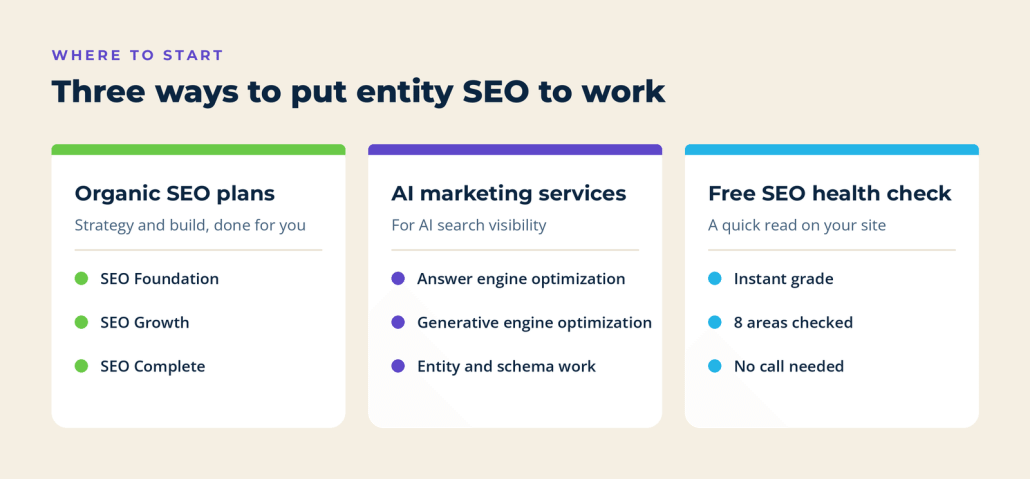
If AI search visibility is the bigger priority, look at our AI marketing services, which include answer engine and generative engine optimization. Want a quick read on where your site stands first? Run our free website SEO health check.
A simple entity SEO checklist
Use this as your first-quarter punch list:
- Standardize your company name and description across your site and profiles
- Publish or refresh an About page with leadership, location and services
- Add Organization and Person schema with stable @id values
- Give every key page one canonical entity: title, H1 and schema in agreement
- Add sameAs links to your official profiles
- Audit listings for name, address and phone consistency
- Build one topic cluster around your most valuable service
- Link related pages deliberately, with descriptive anchor text
- Recheck impressions, clicks and branded versus non-branded queries in Search Console after a few months
Common Questions
What is an example of an entity in SEO?
Is entity-based SEO different from keyword SEO?
What is entity building in SEO?
Do I need a Wikipedia page or Wikidata entry?
How long does entity SEO take to show results?
Sources
- Entity SEO: The definitive guide, Search Engine Land
- Entities In SEO: What Are They And Why Do They Matter?, Search Engine Journal
- Entity-based SEO: An explainer for SEOs and content marketers
- What Is the Knowledge Graph? How It Impacts SEO, Search Engine Land
- Entity SEO is Just SEO
- What is Entity-Based SEO? SEO Best Practices
- What Does ‘Entity Optimization’ Mean?, Search Engine Journal
- When and how to use knowledge graphs and entities for SEO, Search Engine Land
- Entity-first SEO: How to align content with Google’s entity understanding, Search Engine Land
- Impact of Scaling Entity Linking
- Case Study: Entity Linking Increases AIO Visibility